A VPN (virtual private network) connection enables access to network services that require a connection to the campus network. Such services include access to Tableau dashboards, academic software, network file shares, and others. Palo Alto's GlobalProtect is the VPN software you will need to use to establish a VPN connection to campus.

The VPN is intended for use by current students, faculty, and staff only. However, access may occasionally be granted for vendors, consultants, and other Colgate-affiliated users.

Installing the Global Protect VPN Software

Visit our  installation instructions page for full Windows & Mac installation process for laptop or desktop computers.

For iPhone and iPads, visit the iOS installation instructions page.

For Android devices, visit the Android installation instructions page.

Establishing a VPN Connection with Global Protect

  1. Launch the Global Protect software on your computer and Click Connect.
  2. In the web browser pop-up window (see below), enter your full email address and then click Next.
  3. Enter your network | SSO password when prompted and click Sign In. (See below)
  4. If prompted, follow the Duo second factor login process. 


Using the VPN While Traveling or Abroad

Whether you are traveling, studying off campus, or living outside the United States, the VPN can help you reach Colgate resources from wherever you are. How well it performs, and what you should consider before connecting, depends on where you are. Review the guidance below before you leave, or as soon as you can if you are already abroad.

Within the United States, GlobalProtect works the same way it does on campus. You can connect from hotels, airports, conference centers, and other locations.

On public or shared networks, such as hotel, airport, or coffee shop Wi-Fi, we recommend switching to "Full Tunnel" mode for an added layer of security. On a private, trusted network, the default "Split Tunnel" mode is fine. See the FAQ below for instructions on switching tunnel modes.

If you have trouble connecting, contact the ITS Service Desk.

You can use the VPN from outside the United States, but performance can vary from one country to the next. Local network conditions, including limited bandwidth, higher latency, and data caps, may affect your connection speed and reliability.

A few things to keep in mind:

  • Check whether you actually need the VPN. Many academic services, including Moodle, email, and library resources are reachable through a normal web connection and do not require GlobalProtect.
  • Consider "Full Tunnel" mode when connecting from unfamiliar or public networks for an added layer of security. Some countries regulate or restrict the use of VPNs. Before you connect, learn the local rules for the country you are staying in and use the VPN only where it is legal to do so.
  • Some library databases, journals, and online tools may be unavailable or behave differently from one country to the next. Where it is legal, the VPN may help you reach resources you normally use on campus, though access is not guaranteed.
  • Plan ahead. If you expect limited or unreliable access, download the readings, files, and materials you will need before you go.

If you experience access problems while abroad, contact the ITS Service Desk.
 

VPN usage in China requires extra planning, whether you are there briefly or for an extended stay. China's internet restrictions, often called the "Great Firewall," block many of the sites and tools that students and employees rely on for coursework, research, and daily tasks. This includes Google and Google Workspace apps such as Gmail, Drive, and many other widely used services.

  • Use the VPN only where it is legal. The use of VPNs in mainland China is regulated. VPN technology itself is not illegal, but only government-authorized services are fully legal. Colgate cannot advise you to work around the laws of another country. Use the VPN in China only if and where doing so is legal, and familiarize yourself with current local regulations before you go.
  • Access to the Colgate VPN cannot be guaranteed. China actively detects and blocks VPN traffic, and the filtering changes constantly. As a result, GlobalProtect may connect slowly, drop unexpectedly, or fail to connect at all from within China. Do not depend on the VPN for anything time sensitive, such as submitting an assignment by a deadline or completing an administrative task on a fixed schedule. Download the readings, files, and materials you expect to need before you leave, and have a backup plan.
  • Consider an international eSIM for access. Regular Wi-Fi in China, including most hotel and public networks, will typically be subject to the same restrictions and will block many of the services you rely on. Purchasing an international eSIM with a data plan before you go is often a more reliable way to maintain open access, because the data connection routes through a carrier outside of China rather than through the local network. Keep in mind that an eSIM helps you reach general internet services like email and the web. Colgate's own network services, such as file shares and academic software licenses, still require a GlobalProtect connection, which may or may not succeed as described above. Set up and test your eSIM before you leave.

If you have questions about preparing for a stay in China, contact the ITS Service Desk well in advance.
 

FAQs

Imagine your internet connection is a highway, and a VPN is a secure tunnel that helps you travel safely on that highway.

Split Tunnel: You use the secure tunnel only for Colgate-related things, letting everything else take a faster, direct route. It's like having a secret passage just for school or work while the rest of your online activities go on the regular road. This is the default behavior when connecting to the Colgate VPN.

If you are home or on an otherwise private network, we recommend keeping the default “Split Tunnel” behavior for your VPN connection.


Full Tunnel: All of your online activities go through the secure tunnel, making everything as safe as possible, but it might slow you down a bit because every bit of data has to pass through that tunnel.

While the vast majority of network traffic on the internet is encrypted by default, you may consider using “Full Tunnel” mode to add an extra layer of security if you are connecting from a public network, such as one provided by a hotel or coffee shop. You may also consider using the “Full Tunnel” mode when traveling abroad.


You can change between “Split Tunnel” (sometimes listed as “Best Available”) and “Full Tunnel” using the following instructions:

  1. Left-click the GlobalProtect icon, which typically looks like a globe with a shield. On Windows, this icon is located in the bottom right corner, in the taskbar notification area. On MacOS, this icon is located in the top right corner, in the menu bar.
  2. If GlobalProtect is not connected, you will need to click the “Connect” button. Once connected, click on the dropdown menu that appears below the “Disconnect” button.
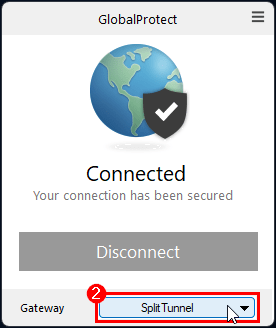
    Image aid for the instructions described in step 2.
  3. Once the dropdown menu appears, left-click on the desired tunnel setting you wish to use.
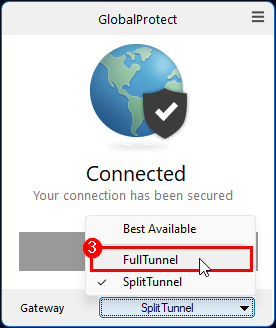
    Image aid for the instructions described in step 3.
  4. Your GlobalProtect VPN will automatically disconnect and reconnect using the new tunnel mode. It may take a few seconds to finish reconnecting. After the VPN reconnects, you will see the new tunnel mode listed below the “Disconnect” button.
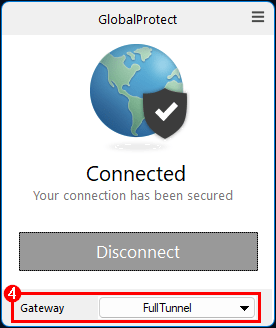
    Image aid for the instructions described in step 4.

ITS implemented Duo multifactor authentication protection to the GlobalProtect VPN to add another layer of security to your account.


The sign-in page is powered by Microsoft, which Colgate is transitioning to for authentication to services.

Ask for Help

If you are unable to find the information you need in the documentation available online, the ITS Service Desk is available to assist.