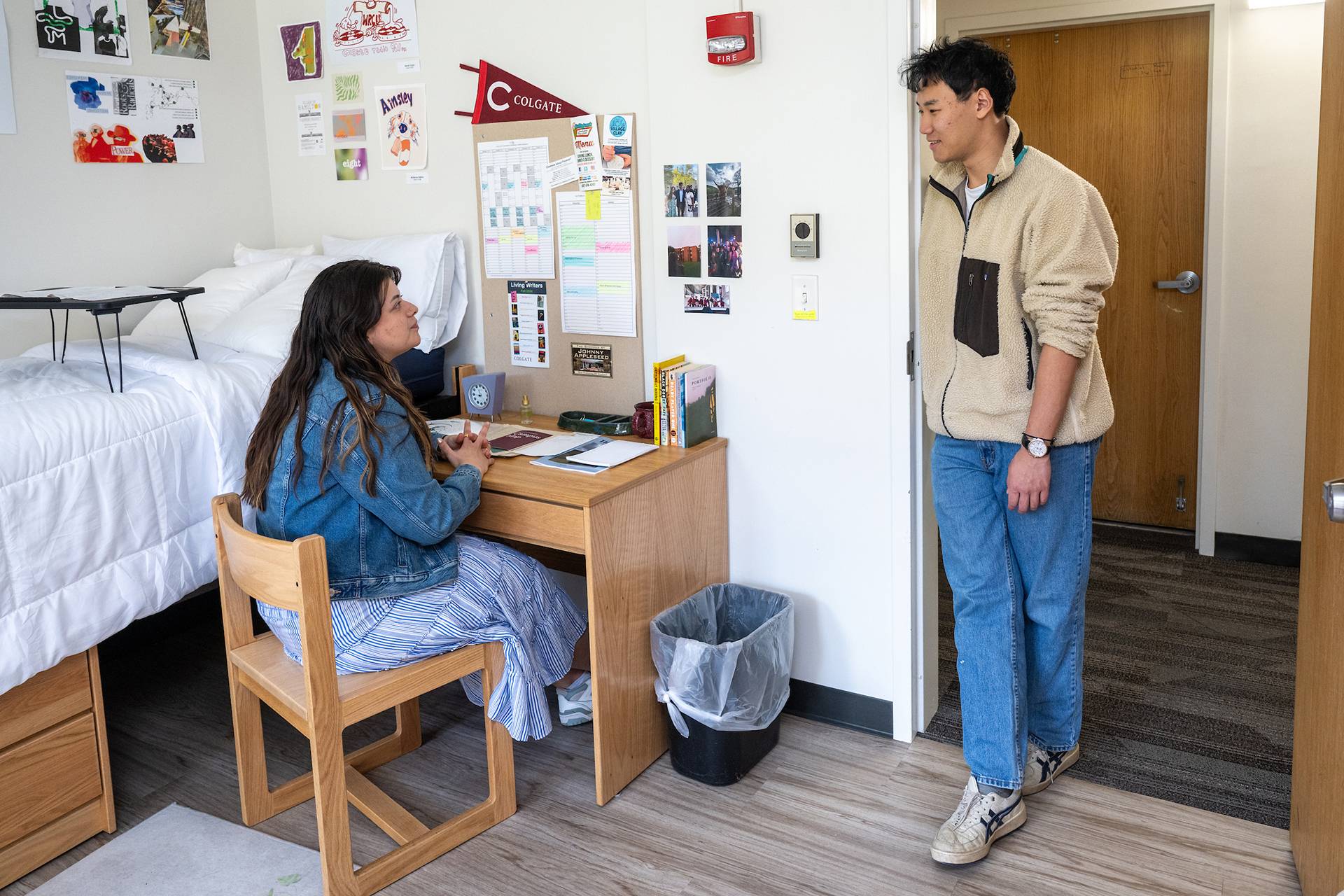
We asked Colgate’s residential life professionals for their insights on housing selection and how they help students find meaning and purpose in their living situations.
The housing selection process for returning students organizes them into safe spaces where they can succeed academically, grow as individuals, and live with people who matter to them.
Between varied housing types and a process that offers options based on class year, placing around 2,800 students is an intricate puzzle.
Here, we offer information, context, and conversation tips to help as your student navigates housing selection.
Tips Residential Life Share With Students
Understand the Process and Resources
Each year, the Office of Residential Life hosts information sessions before the process kicks off, and their website remains an excellent resource. The staff also works closely with students to answer individual questions at any stage of the journey.
Through in-person and virtual appointments, the Office of Residential Life can help students identify comfortable housing options, find potential roommates, or build a selection strategy. The better the staff understands a student’s interests, the better they can guide them — so please encourage your student to reach out.
The selection process moves in phases, beginning with application-based options followed by the general lottery. These applications differ for rising sophomores versus rising juniors and seniors. Because deadlines vary, it’s vital that students keep an eye on the schedule and ask questions early. Just keep in mind: once a student is accepted through a specific process, that housing assignment is final.
Develop Goals and a Set of Choices
Setting clear goals — and ensuring students and their potential roommates are on the same page — goes a long way toward creating a smooth housing process. To prepare, the residential life team recommends these strategies:
• Review materials carefully to stay informed about all available options.
• Identify specific goals for the upcoming residential experience.
• Consider the type of living situations and the residence halls of interest.
• Use the housing portal to find roommates, search for options, and form groups early.
• Stay flexible by identifying several different choices that they would be comfortable and happy with.
Managing expectations is important. Given the complexity of placing so many people in a finite set of spaces, it’s impossible for everyone to get their top choice. It’s also important to note that more than two-thirds of Colgate’s housing inventory is multi-occupancy spaces, with doubles being the predominant setup, whether in traditional residence halls, suites, or apartments. Many students in all class years, including seniors, are likely to have at least one roommate.
Value People Over Place
Through the strong foundational community built through their Residential Commons membership in the first and second years, as well as classes, activities, sports, and social time, there are ample opportunities for students to build meaningful relationships.
Because these relationships help define the living experience, students are encouraged to prioritize who they live with or which programs they join over specific residence halls or room types. Focusing on their community, rather than a floor plan, ensures a more rewarding outcome.
It May Take Some Time
It’s important to know that, for various reasons — such as a missed time slot, confusion with the process, or challenges with potential roommate groupings — some students may not have their selection completed through the general lottery. Students who do not choose housing during the initial selection process should complete the housing waitlist form. The residential life team works with these students to make sure they get a placement.
There will be some spaces immediately available, and additional spaces will become available over the spring and summer as other students solidify their plans for the upcoming academic year, such as changing study abroad plans or taking an unexpected medical leave.
If your student finds themself on the waitlist, encourage them to be patient and flexible as options emerge. This is a planned function of the process — it operates much like course selection, where students can adjust their schedules through Drop/Add as seats open up after registration.
Remind them that Colgate guarantees housing for all four years of the undergraduate program*. As part of the four-year residency requirement, all undergraduate students in good standing will receive a room assignment. The residential life team does its best to make the closest possible match to their preferences.
*For students enrolling beyond the standard eight undergraduate semesters, Colgate is unable to provide housing.
Other Important Guidance
Accessible Housing
For students with disabilities that impact one’s residential environment, the Office of Student Disability Services (OSDS) works closely with the Office of Residential Life to provide accessible housing. Reasonable and appropriate housing adjustments are determined upon careful review of the student’s disability, the residential environment, and the measures that may be necessary to provide the housing adjustment. Returning students are expected to submit an application by the date communicated in their recent residential life emails and on the housing portal. Learn more by downloading the OSDS Requesting Accessible Housing Consideration Guide.
Gender-Inclusive Housing
The Office of Residential Life is committed to providing a living environment that is welcoming to all gender identities. Campus housing options include a variety of gender-inclusive rooms such as suites, apartments, and townhouses.
Senior-Year Off-Campus Housing
Colgate is a four-year residential university. Historically, we permit a limited number of seniors — approximately 30 percent — to live in private off-campus housing. This is not a guarantee; interested students must apply and secure a slot through a lottery during the fall of their junior year.
Applicants must demonstrate a pattern of respectful community behavior. Students in good standing will receive notice of eligibility from the residential life office. Crucially, students should not sign a lease before receiving official approval. Doing so does not release a student from the residency requirement, and they may become responsible for both University housing costs and their private lease.
Helping Your Student
The housing selection process can be stressful. Consider sharing a time you faced a complex decision, pivoted from a plan, or made a compromise. How did you approach it, and what tools helped you find a solution? Sharing your own experiences can help your student focus on what they can control and embrace the outcome.
Conversation Starters
If your student expresses any uncertainty or mentions that they are encountering difficulty with the housing process, ask open-ended questions that help them manage their expectations, plan productively, and problem-solve.
• What are your goals for your housing experience?
• What kind of setting do you think you will function best in and why?
• What resources can you tap?
• Have you attended an information session?
• Have you spoken with a member of the residential life staff?
• What did you/do you plan to discuss with them?
Learning Moments
Everyone hopes for an early slot in the housing lottery. Yet, the very fairness of a randomized process means that while someone goes first, someone else must go last. The lottery process is built for transparency and equity by assigning a randomly generated selection time to each student.
If your student receives a less-than-ideal timeslot in the lottery and is upset, lend a sympathetic ear while helping them maintain perspective. It isn’t personal — sometimes circumstances simply come down to the luck of the draw. Encourage them to work with their roommates and consult with the residential life staff; they are here to share strategies for navigating the process and maximizing their options.