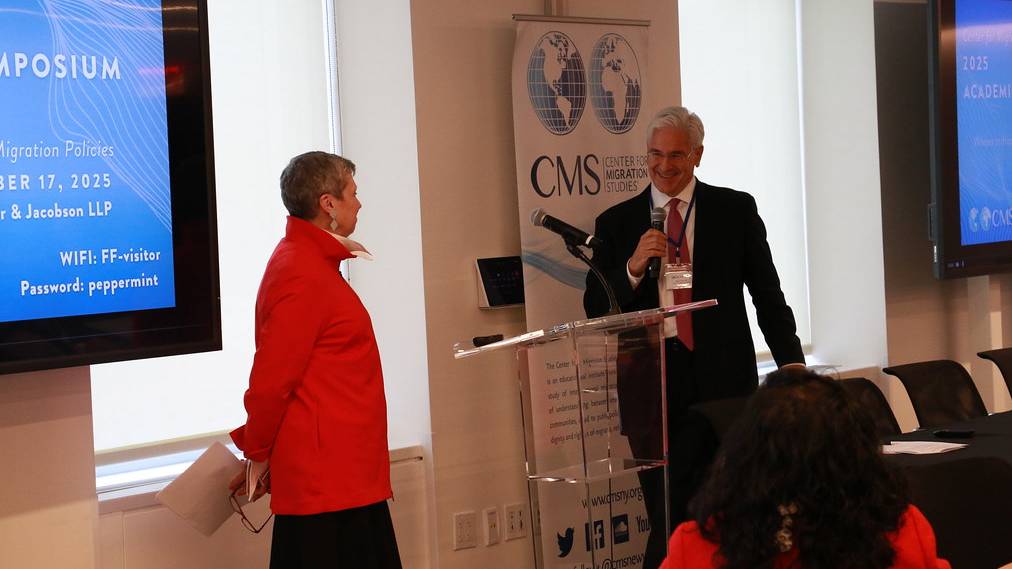
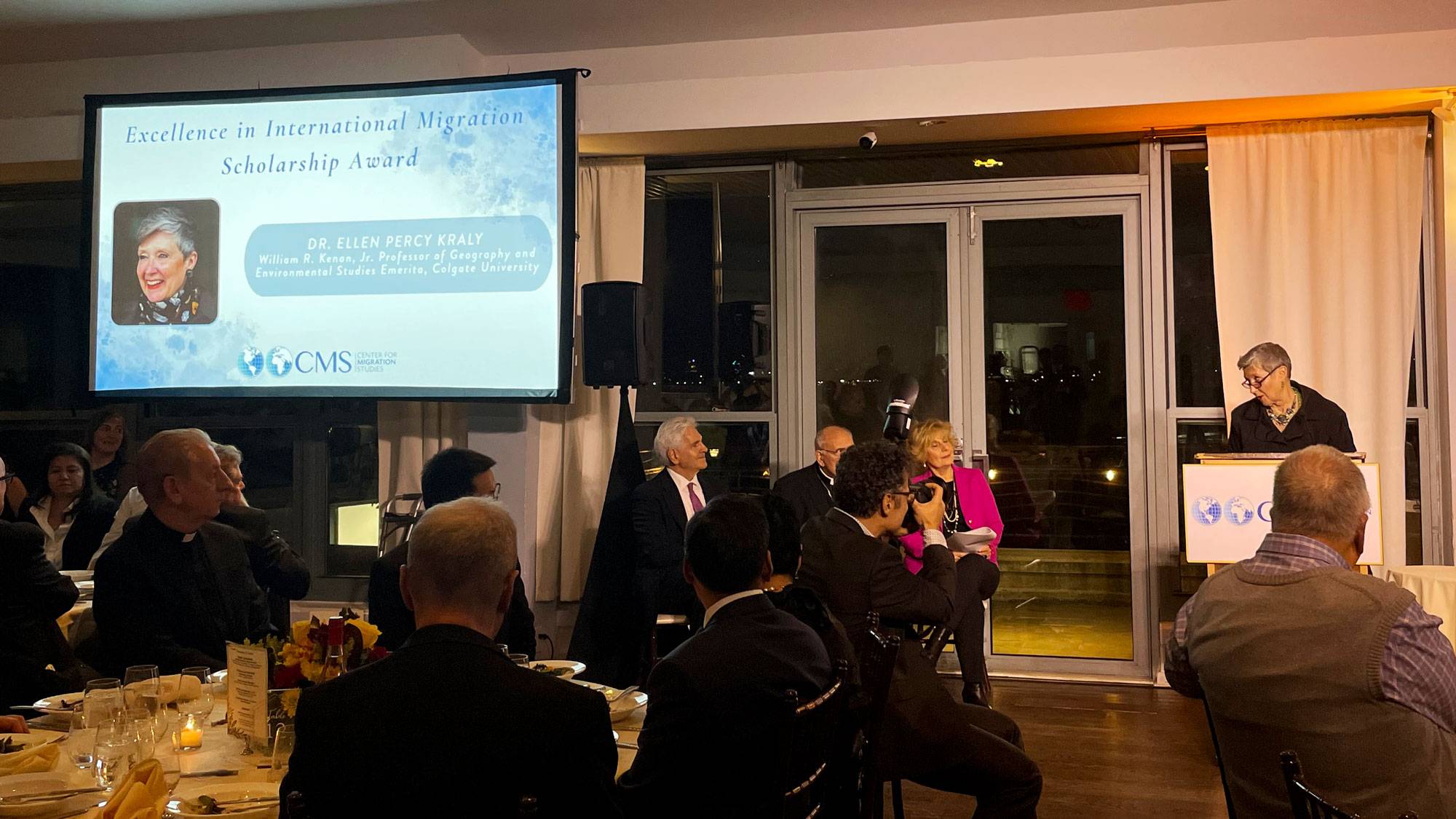
Colgate University’s William R. Kenan Jr. Professor of Geography and Environmental Studies Emerita Ellen Percy Kraly was honored by the Center for Migration Studies at its 2025 Academic and Policy Symposium in New York City on November 17.
Kraly received the Excellence in International Migration Scholarship Award for “extraordinary contributions to international migration scholarship and research, to understanding and caring for those seeking protection throughout the world, and to educating and inspiring future generations.”
Kraly retired from Colgate in 2023 after teaching and serving in academic administration for nearly 40 years. In addition to being active in Colgate’s Upstate Institute, study abroad, and service-learning pedagogy, Kraly’s research has focused on the demography of international and forced migration and environmental and gender dimensions of migration. She has conducted projects for the United Nations Population and Statistical Commissions, the National Academy of Sciences, and the U.S. Commission on Immigration Reform and represented the population sciences in the consultations regarding the U.N. Global Compact on Safe, Orderly and Regular Migration.
The role of her peers was a key theme in her acceptance speech. “Colleagues from so many corners of the community of migration and population scholars have contributed to my growth and my work, and my character,” she said.
Kraly delivered the keynote address, “Bearing Witness: International Migration Studies, Scholars, and Students,” at the day-long academic symposium. She focused on the momentum in migration studies to generate findings that are rigorous and can also inform migration policy.
Kraly emphasized the importance of interdisciplinarity perspectives in the study of population movements, migration, and displacement, and also the essential element of collaboration across diverse fields, geographies, and among migration researchers, practitioners, students, and migrants themselves.
Kraly went on to discuss how the availability of data in her field is abundant — something about which to be hopeful — but she also took the time to acknowledge a gap between the amount of data produced and the way data is conveyed to the public, saying that “what we lack is perhaps not access to data but effective access to data.”
The issue of data accessibility was at the forefront of Kraly’s mind in her service to The Center, a nonprofit organization supporting refugees and migrants in Utica, N.Y. Kraly worked closely with the leadership to communicate in straightforward terms the effect of refugee settlement in stemming population decline in the city.
“Colleagues at The Center required an accurate but concise and meaningful message of the demographic impact of refugees,” Kraly explained. “The key was listening to the staff about how to make the data compelling to civic leaders.”
A broad and critical perspective has informed her own research on the demography of U.S. immigration and forced migration, as well as her roles as editor of the Center for Migration Studies’ International Migration Review.
Kraly explained. “My effectiveness as an editor reflects in large part my exposure here at Colgate to interdisciplinarity, talking across analytic difference, and the humility to listen and learn from others.”
The role of emerging scholars provides another reason for Kraly to be positive about the future of international migration studies. Kraly has always been deeply moved and motivated by the passion and intellectual curiosity demonstrated by the undergraduate students she taught at Colgate. According to Kraly, her students didn’t seem to be showing up to fulfill an academic requirement; they were working toward finding solutions to real-world problems.
“The momentum of migration scholarship requires the inclusion of students. Full stop. While I was an active instructor at Colgate, students demonstrated so much energy and creativity, commitment and desire to contribute in constructive ways. That does give me hope,” Kraly said, urging her peers to see and utilize the “hunger in students to use their critical skills to make a difference.”
“The trajectory of migration studies toward interdisciplinarity and collaboration,” Kraly said, “gives me hope for our capacities as scholars and students to bear witness to evidence, and to communicate, to listen to one another, with a hope to promote justice and kindness in migration policy and in our communities.”