When Associate Professor of History Alexander Karn started to piece together his academic plans for his 2025 first-year seminar (FSEM), he had a childhood friend from Pittsburgh in mind.
That course development, Karn said, was the perfect opportunity to collaborate with a long-time friend, Leonard Brown, who is also now the vice president of student affairs at Norfolk State University.
“Leonard and I have been talking for years about how to connect our students through a linked teaching experiment,” Karn said. “The older we get, the more we talk about things we didn’t discuss as teens. He’s deeply interested in America’s past, the histories of race and racism, and where the country goes in light of this history.”
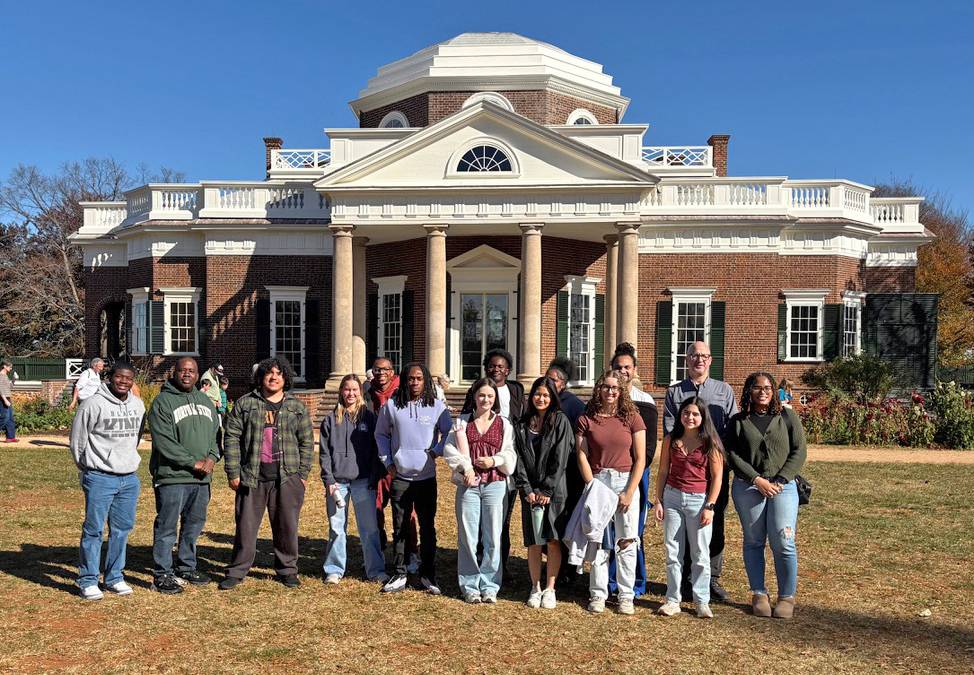
What emerged was a new first-semester seminar at Colgate, titled Historical Justice in America, and a pilot leadership seminar led by Brown at NSU. While the courses had their own content and structure, they incorporated common readings and a series of online meetings where students from the two universities met to discuss the shared materials and the relationship between past and present. Thanks to support from the Provost and Dean of Faculty’s Beyond Colgate initiative, the linked online sessions culminated with the students meeting in person at Thomas Jefferson’s Monticello in Virginia.
“One theme of our discussions focused on difficult history, the history of slavery in America, in particular, and what role our Founding Fathers played in it,” Karn said. “Both groups had a lot to say about what we owe to the past and how to ensure that unheard voices are integrated into our national history.”
At Monticello, the students took a special guided tour of the property, including the quarters where some of Jefferson’s more than 600 enslaved people lived.
“I found it exceptionally interesting to hear the Norfolk students' thoughts on how slavery is taught through specific word choices at Monticello,” said Leah Reichman ’29. “This tour was unlike any museum tour I had ever done before. Instead of spitting out information and statistics at us, our tour guide would share a piece of Thomas Jefferson’s life, and then we would be encouraged to discuss it as a group.”
Katie Niven ’29 shared that she, too, took a lot away from the course and the experience of talking about difficult historical topics with peers from another school. “It was very impactful to discuss what we are learning with like-minded individuals outside of the Colgate community. This trip has continued to impact the way I interact with course material and participate in class discussions.”
For Brown and Karn, seeing the students come together at Monticello was the moment that they had hoped for during those early days of planning their collaboration. It’s one thing to talk with students about how to critically evaluate museum displays and descriptions, but it’s another when faced directly with the realities of the past.
“I think that’s what education is about. We want students to be able to ask those questions and to go through their own thought process to figure it out, and to process that with other people who are experts in this area,” Brown said. “If these students are going out to be the leaders of tomorrow, they need to understand the history that’s around them, but also how that history still influences what is happening today. The feedback I got overall was extremely positive. I think our interactions with the Colgate students brought different backgrounds and experiences to the classroom, and it also led us to explore some of their commonalities.”
Karn shared the same opinion of the impact the class had, and he hopes to teach the FSEM again in the future. “It was one of the most interesting and rewarding experiences I’ve had in my 20 years teaching,” he said.