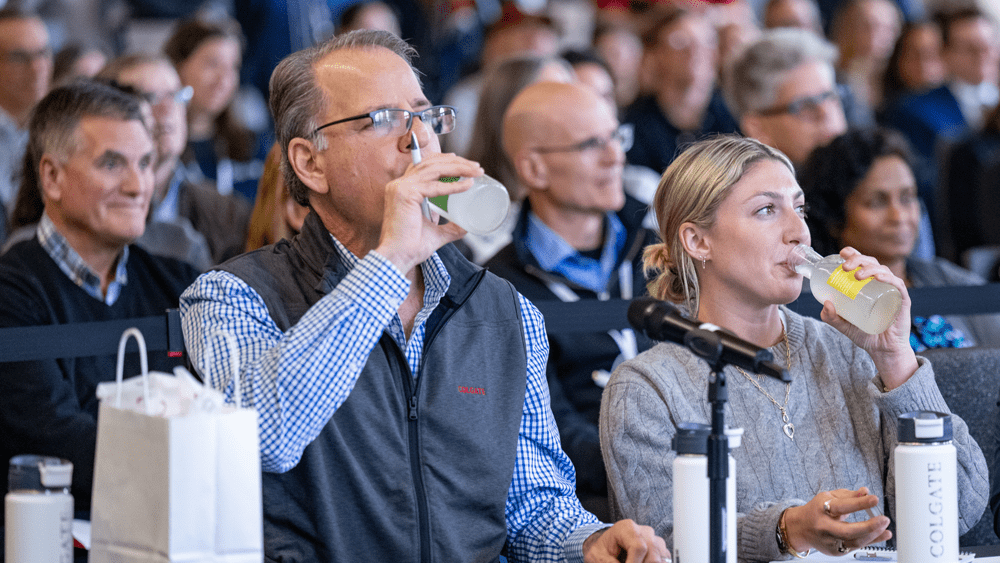
Judges Michael Ellenbogen ʼ86, Pʼ26 (left) and Caroline Danehy ʼ19 test a beverage product from Charlotte Prendergast ʼ25 during the 2025 Entrepreneur Showcase.
One venture is redefining immersive experiences through therapeutic sound and tech innovations. Another is tackling water scarcity one sustainable borehole at a time. A next generation digital wallet will unlock all available rewards, and a software program will modernize the plant industry with digital solutions that aim to grow ideas and green spaces.
These are the four ventures that have been selected to pitch during the 2026 TIA Entrepreneur Showcase as part of Arts, Creativity and Innovation Weekend. On April 11, they’ll have the chance to present their ideas, compete for funding, and take a real step toward launching their businesses. Chosen from a large pool of applicants, these finalists represent a mix of creative, technical, and social impact–driven ideas that show how much entrepreneurship is growing on campus.
Arts, Creativity, and Innovation Weekend is one of Colgate’s newest and most exciting traditions because it gives students the space to turn ideas into something real. The weekend brings together students, alumni, faculty, staff, and the community for workshops, conversations, and a live pitch competition. At the heart of it is the Entrepreneur Showcase, an opportunity for TIA participants to try new things and learn fast, and this April, these four founders are right at the center of it.
The Showcase finalists — Agnes Ndanu ’28 of MajiSafi Solutions (water scarcity), Porter Comstock ’26 of PLNT (modernizing the plant industry), Fletcher Goodell ’26 of Hatch Pay (digital wallet), and Mike Ahearn Wilcox of EchoScape (therapeutic sound design) — were chosen from many applicants, making the announcement especially meaningful for each of them.
For Ndanu, whose venture focuses on social impact, being selected felt deeply personal. “It felt super good to be chosen, especially knowing so many teams applied and only four could move forward,” she said. “My venture is the only one in the social impact space, so it really means a lot to me and to the community I want to serve. My first emotions were just happiness and excitement, and I’m so looking forward to the April showcase.”
Goodell said the experience was rewarding even before he found out he was selected. “Just applying was a great opportunity,” he said. “We were asked questions we hadn’t really thought about before, and I think our strongest point was how we answered them. Walking away feeling good even before hearing back was an amazing feeling.”
Wilcox described the moment as both emotional and validating: “I was stressing that I didn’t get it, and then I saw the email saying I’d be pitching. I felt incredible — like the hard work is finally paying off.”
The $10,000 top prize will play a big role in helping each venture grow and take real steps toward launch. For many of the finalists, this funding represents their first major investment and a chance to test their ideas outside the classroom.
Comstock’s project relies on hardware, making the funding especially important. “My venture requires drones. The money will help us buy and test different models. We’re also working on a machine-learning counting model and securing our first paid pilot by February.”
Goodell said his team will use the funding to improve its data and prepare for its first real launch. “Our biggest focus is data quality,” he said. “We want to fund faster data processing so we can scale. The sooner we launch, the sooner we can collect more data, ask better questions, and learn more about our users. We’re excited to connect with people and capture more nuance as we grow.”
Wilcox shared that the prize would help him finally bring his idea to life. “Having $10,000 to start my venture will help me be in a really good spot,” he said. “It gives me the confidence to take the next step and see where this idea can really go.”
Between now and the pitch competition, each finalist is focused on refining their work, building stronger pitches, and learning as much as possible from mentors and peers.
Ndanu is working on strengthening her pitch and storytelling. “I’m mostly focusing on my slides and the story I want to tell,” she said. “I want the pitch to feel strong, clear, and meaningful, and really communicate why this work matters.”
Goodell said his team isn’t worried about the idea itself — the focus is on building the product.
“Our pitch will mostly stay the same,” he said. “For us, it’s about iterating on the product and getting a live demo ready. We’re hoping to launch with friends and family before the competition, so having that ready will be huge and give us valuable feedback.”
Wilcox is using feedback from an alternate experience of his project in The Vault to improve. “I’ve learned a lot from customer feedback [following the recent exhibition] and I really want to dive into the financial side of entrepreneurship. I’m working on tightening my pitch and understanding all parts of running a business before the Showcase.”
With just a few months left to prepare, the four finalists are focused on growth, collaboration, and making the most of this opportunity. As the Showcase approaches, they hope their ideas will not only impress the judges, but also inspire other students to pursue their own entrepreneurial paths.
Arts, Creativity, and Innovation Weekend honors the spirit of the Middle Campus Initiative — a centerpiece of Colgate’s Third-Century Plan.