For just over a decade, the ghost of an idea lived in the back of my mind — a world built not of pixels, but of sounds. It wasn’t until I began my Master of Fine Arts thesis at Syracuse University that EchoScape finally found its voice.
The proof of concept started out as a sonic exploration piece: the player would explore a video-game-like world through audio-only means. But, as I started programming and utilized a PlayStation 5 DualSense controller to manipulate audio effects in this space, such as reverb, the idea quickly evolved. The piece personally started to have an impact on me — in a meditative sense — so I decided to lean into that.
I am someone who lives with anxiety and have had issues with meditation in the past. My mind wanders — which is typically normal in meditation, but with anxiety it can sometimes wander to dark places. I noticed that when I was interacting with the PlayStation 5 controller to directly manipulate the soundscapes of this meditative space, my mind was able to stay more focused; it allowed me to get a better experience out of the meditation. This idea can be supported by meditation-in-motion styles — such as tai chi and yoga as well as walking meditations — but the important aspect is bringing it into to the modern day with technology. Giving yourself a physical tool to interact with while meditating can make it easier for your mind to stay engaged with the experience.
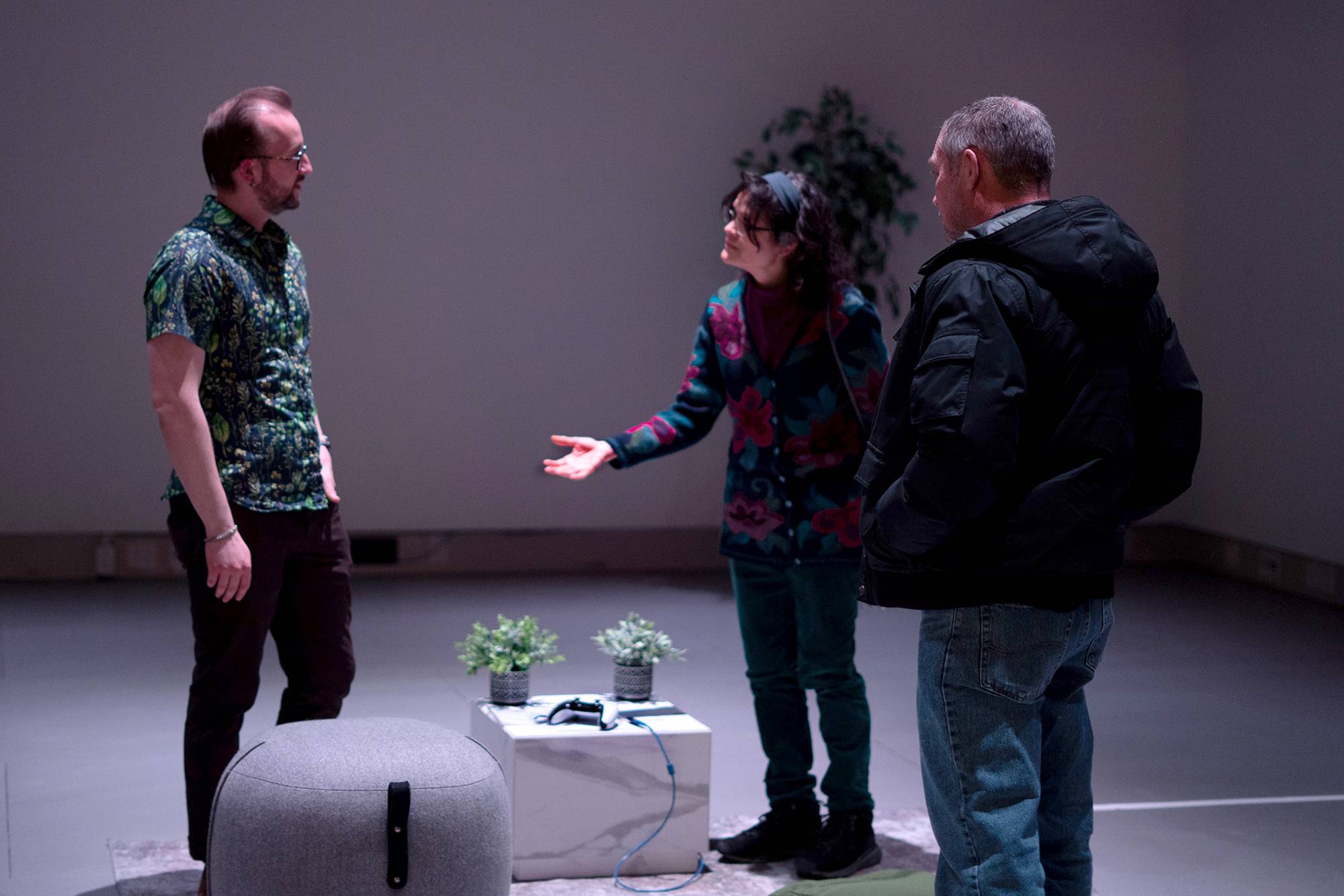
My project was originally designed and built for use with stereo headphones and a PlayStation 5 controller, but I had envisioned a larger exhibit, one that would involve 360-degree spatial sound and lighting. As a member of the ITS staff at Colgate University, I was privy to the capabilities of The Vault in Bernstein Hall; I figured that would be the perfect spot to try out this experiment. My proposal for an exhibit in The Vault was accepted for a three-day run in early February. In the two weeks leading up to my exhibit, I worked closely with Patrick Taylor, artistic and technical support manager of The Vault. Through his technical prowess, Patrick was integral in helping me achieve my vision by connecting my proprietary programming to the internal sound and lighting systems of this space. Once I gained direct control over the lighting system — such as the RGB colors and dimming of each lighting fixture, as well as the 360-degree speakers with a PlayStation 5 controller — I was inspired with creativity. Much of my time during those two weeks was spent prototyping new ideas that I could implement into this space; needless to say, I was very satisfied with the results.
In addition to tapping into Patrick’s expertise, I worked with Isee Martine, the assistant technical director in the theater department, to add ambiance to the exhibit. Isee helped me find potted plants and a rug to use for this exhibit in order to set the vibe for a more meditative and relaxing experience. Isee, with their lighting expertise, also assisted Patrick and I when we were learning to program the lighting console. In this process, we found out that remote variable control of a lighting console is quite atypical, possibly an application that is the first of its kind. More conventional usage is trigger commands, such as lighting cues for musicals.
With that being said, we did find a workaround that allowed us to variably control the colors of the lights, which felt like a monumental accomplishment in just two weeks and made this experiment even more unique. The lights, 360-degree spatial sound, and the added props elevated the EchoScape experience. My learnings from this exhibit will be incorporated into a final app/video game design for computers and mobile phones.
The EchoScape exhibit was promoted as an immersive and engaging sound art installation, but it also doubled as a hands-on demo/playtest of my venture product. A survey recorded the thoughts of 40 participants after their interactions with the exhibit. These responses have given me valuable customer insights in order to refine concepts of EchoScape as a business; next I plan to move forward with development of an app that will be utilized for a larger scale playtest. The reception from the more than 100 visitors was overwhelmingly positive. Ninety percent of them mentioned that using the PlayStation 5 controller had a positive effect on them, they reported being more present and still during this meditative experience. It really is validating to see that this idea, which when originally created it assisted my own anxiety, has the potential to help so many other people. In addition to creating a new demo, I am also working on homing in on my target audience, branding, and ROI projections.
I would like to thank Christian Vischi, the E&I marketing interns, Jen Martin, and Carolyn Strobel-Larson as well as my TIA mentors for supporting me during the promotion and customer research development of the EchoScape exhibit. E&I and TIA have been a huge help with pushing my idea forward and connecting me with the right people in order to get this product to the finish line. I really am excited to see where this takes me.