Rogue waves are exactly what they sound like: enormous, unpredictable waves that come out of nowhere. Olivia Schlegel ’27 (applied mathematics and economics double major) has been working alongside Associate Professor of Mathematics Nick Moore for the last two summers, digging into the mathematical model of wave behavior to identify any predictors that might explain why rogue waves form.
“It could be a seemingly smooth, clear day, and all of a sudden this huge wave will come — which can obviously be problematic for boats or people out on the water,” Schlegel explains.
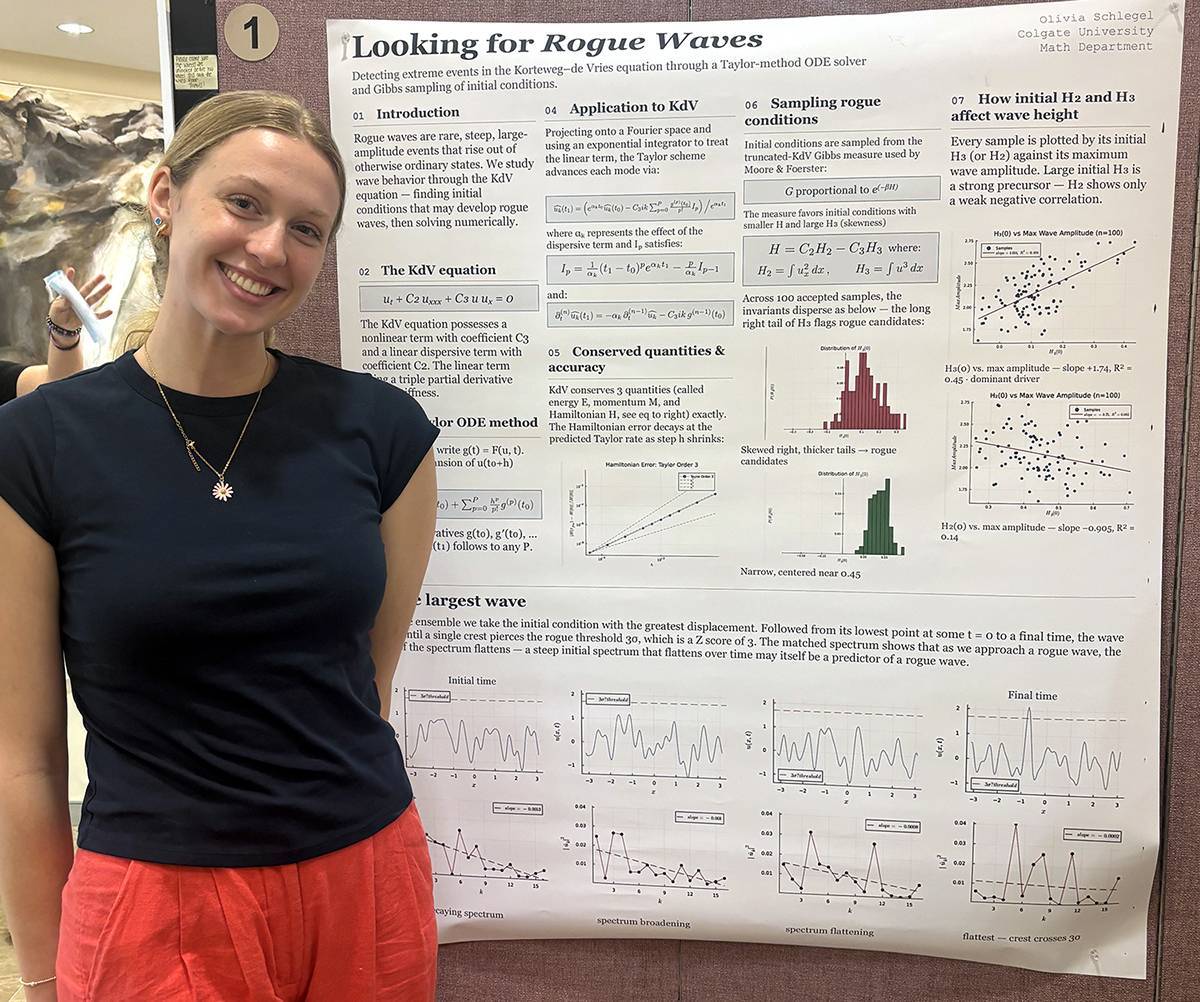
Schlegel analyzes waves drawn from a sampling code built by Moore and Brendan Foerster ’24. The code pulls random wave samples from a Gibbs distribution, a probability distribution designed to mimic the natural randomness of systems like the ocean by maximizing entropy, or disorder. The researchers attempt to increase the possibility of rogue waves by tuning inverse temperature, a control parameter within the system. From there, Schlegel’s computer simulates the precise physics of waves over time, revealing how candidate waves can go rogue.
Oceanographers define rogue waves as those that reach a z-score of 4, which occurs for few waves within Schlegel and Moore’s coding sample. The team uses a partial differential equation called the Korteweg–de Vries (KdV) equation to model how the waves behave over time. Within that model, three values — momentum, energy, and a quantity that is known as the Hamiltonian — remain constant as the wave progresses. The Hamiltonian is made up of two components: H2, the variance of the slopes of the waves, and H3, the skewness of waves.
The preliminary prediction Schlegel continues to investigate concerns the H3 value. In the samples, it seems that if a wave has a high H3 value at its initial point of analysis, it has a high likelihood of progressing into a rogue wave. While the research is still ongoing, Schlegel noted progress from her first summer working on the project.
Last summer was spent largely getting up to speed by learning Moore’s coding environment and working through the complex mathematics of partial differentials and Fourier coefficients — concepts not taught in her undergraduate coursework. “This summer I feel like we’ve hit the ground running because I had all of that preliminary conceptual understanding,” Schlegel says. “I would definitely say it’s been very worthwhile to do it two summers in a row.”
After Colgate, Schlegel plans to pursue graduate school in mathematics, as inspired by her work with Moore.