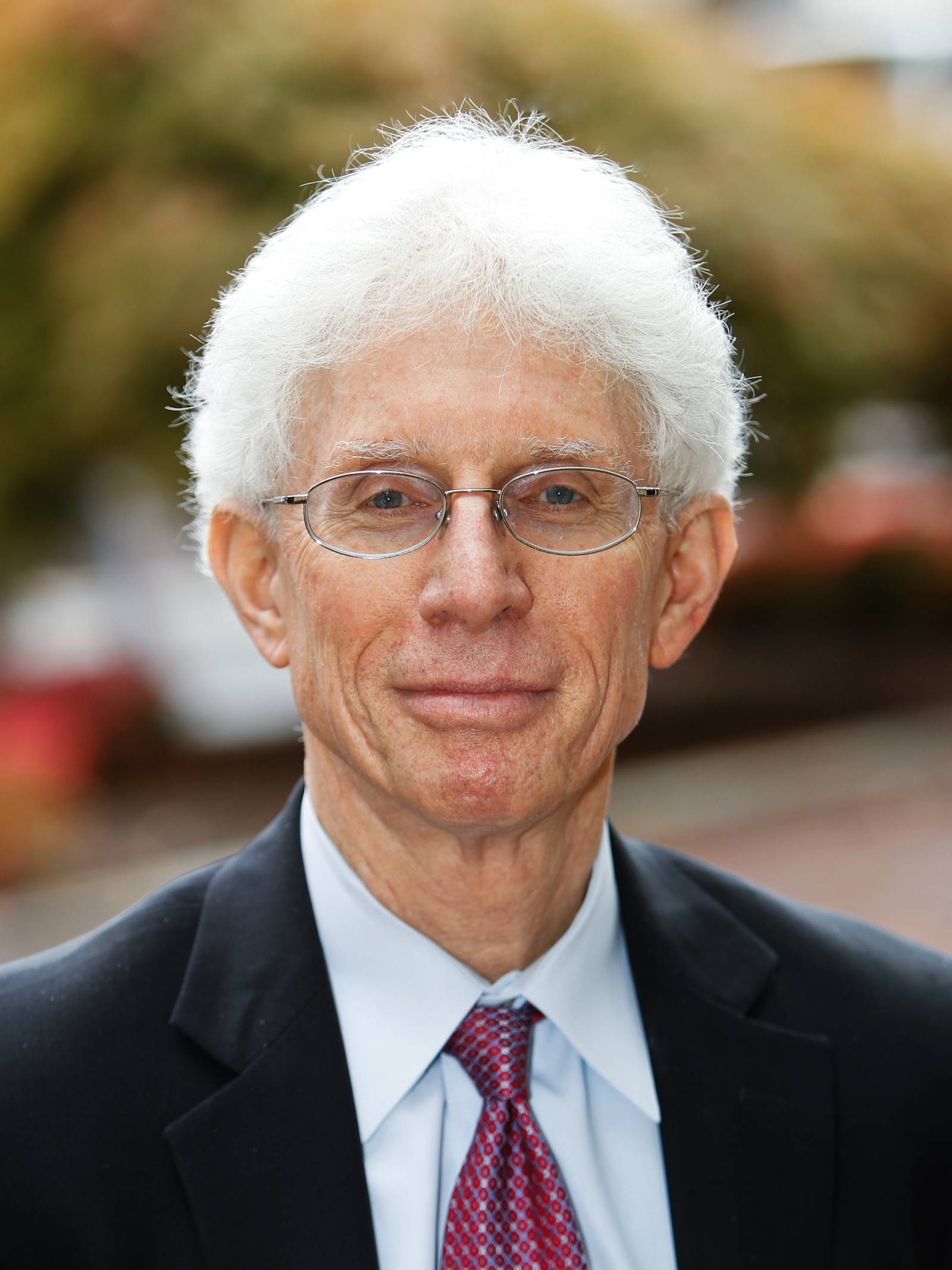
Prominent scholar of democracy William Galston visited campus Oct. 21 to shed light on the current threats faced by the U.S. and democracies around the world, especially internal pressure from what he refers to as “the new populism.” His lecture, “Worldwide Threats to Constitutional Democracy,” was sponsored by the Colgate Department of Political Science’s Louis Rakin Foundation grant.
Galston holds the Ezra Zilkha Chair in the Brookings Institution’s Governance Studies Program, where he is a senior fellow. When he first joined the National Endowment for Democracy board in 2006, global democracy seemed to be on the rise, having grown from 39 liberal constitutional democracies in 1973 to 123 by 2005. Galston said he later realized he had joined the board just as the global movement toward democracy had peaked and started the decline that continues today. He said that between 2009 and 2025, the number of liberal democracies fell by more than one-third from its peak in 2005. By 2025 — for the first time in decades — there were more autocratic governments in the world than democratic governments.
While large authoritarian regimes such as Russia and China exert external pressure on liberal constitutional democracies, Galston said the greater protest originates from within democracy itself through “new populism.” This new populism is “hostile to liberal constitutional democracy in the name of pure democracy — the rule of the majority of the people, unchecked and unhindered,” Galston said. “The new populists argue that the liberal and constitutional elements of liberal constitutional democracy are fundamentally undemocratic and work to nullify the will of the people.”
Galston said populists attempt to bypass institutions they believe distort the will of the majority, favoring direct connections between leaders and citizens — which leads to increased executive power at the expense of legislatures, courts, and bureaucracies. The populist desire to immediately implement the will of the majority creates tension with constitutions that put limits on institutional power, secure minority rights, and slow down the decision-making process. Liberalism itself, which he defined as a doctrine of individual equality, rights, and limited government, also comes directly into conflict with new populism’s focus on the majority.
This rise in new populism stems from multiple areas, Galston said, including immigration policies, geographic and class impacts due to globalization, and cultural changes around religion and gender. Galston also noted globalization benefited mostly metropolitan areas and those with a college education, but negatively impacted those from small towns and those without degrees, creating a “working class revolt.” While he acknowledges populism raises legitimate policy issues, he said it also illegitimately attacks liberal constitutional institutions including independent courts, free press, and civil society. Galston said he firmly believes a liberal constitutional democracy is “the best form of government imaginable under modern circumstances to serve our interests while keeping us free.”
“It’s the responsibility of all of us who believe in the institutions that we inherited, who know that these institutions need reform, who know that long-ignored problems need to be central to the public agenda to respond not just with alarm — although alarm is justified — but also with a renewed burst of policy and institutional creativity,” Galston said.
A participant in six presidential campaigns, Galston served from 1993 to 1995 as deputy assistant to President Bill Clinton for domestic policy. He previously served as a professor and acting dean at the University of Maryland’s School of Public Affairs and founded the Center for Information and Research on Civic Learning and Engagement in 2001.
Galston is the author of 11 books and more than 100 articles in the fields of political theory, public policy, and American politics. His most recent books are Anti-Pluralism: The Populist Threat to Liberal Democracy (Yale, 2018) and Anger, Fear, Domination: Dark Passions and the Power of Political Speech (Yale, 2025). A winner of the American Political Science Association’s Hubert H. Humphrey Award, he was elected a Fellow of the American Academy of Arts and Sciences in 2004. He also writes a weekly column for the Wall Street Journal.