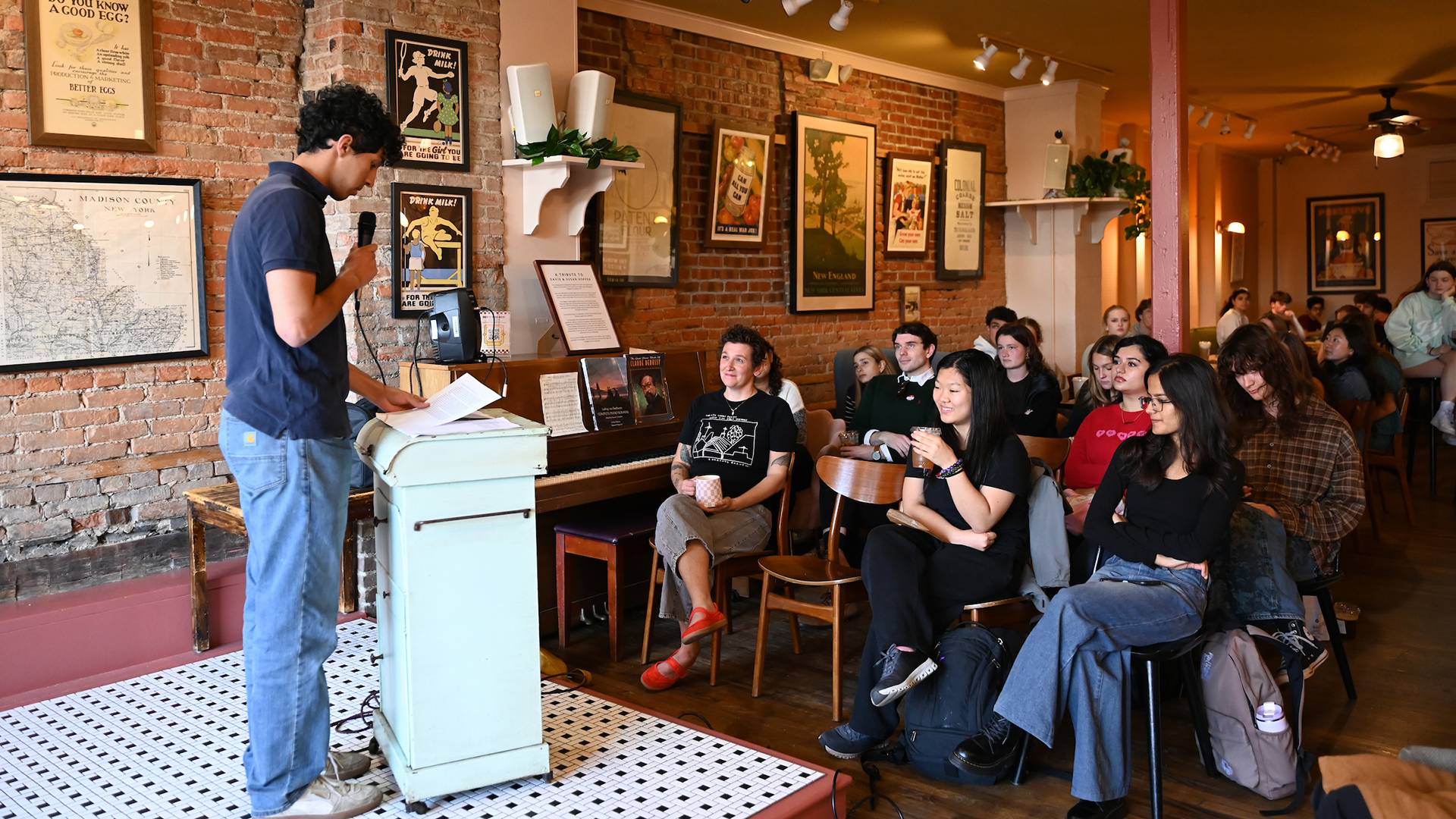
When Nouri Badrous ’29 stepped up to the lectern to read, he was nervous. Then the audience laughed.
Badrous read a series of “delights” on Oct. 29 at Flour & Salt in Hamilton, N.Y., one of 12 students who shared creative writing at an after-hours coffeehouse reading by students in Colgate’s Living Writers course. His pieces were modeled on Ross Gay’s The Book of Delights, which celebrates the beautiful things in everyday life.
“I was surprised to hear the audience laugh because obviously I thought my delight was funny to me, but it was nice to hear that others saw the humor in them as well,” Badrous said.
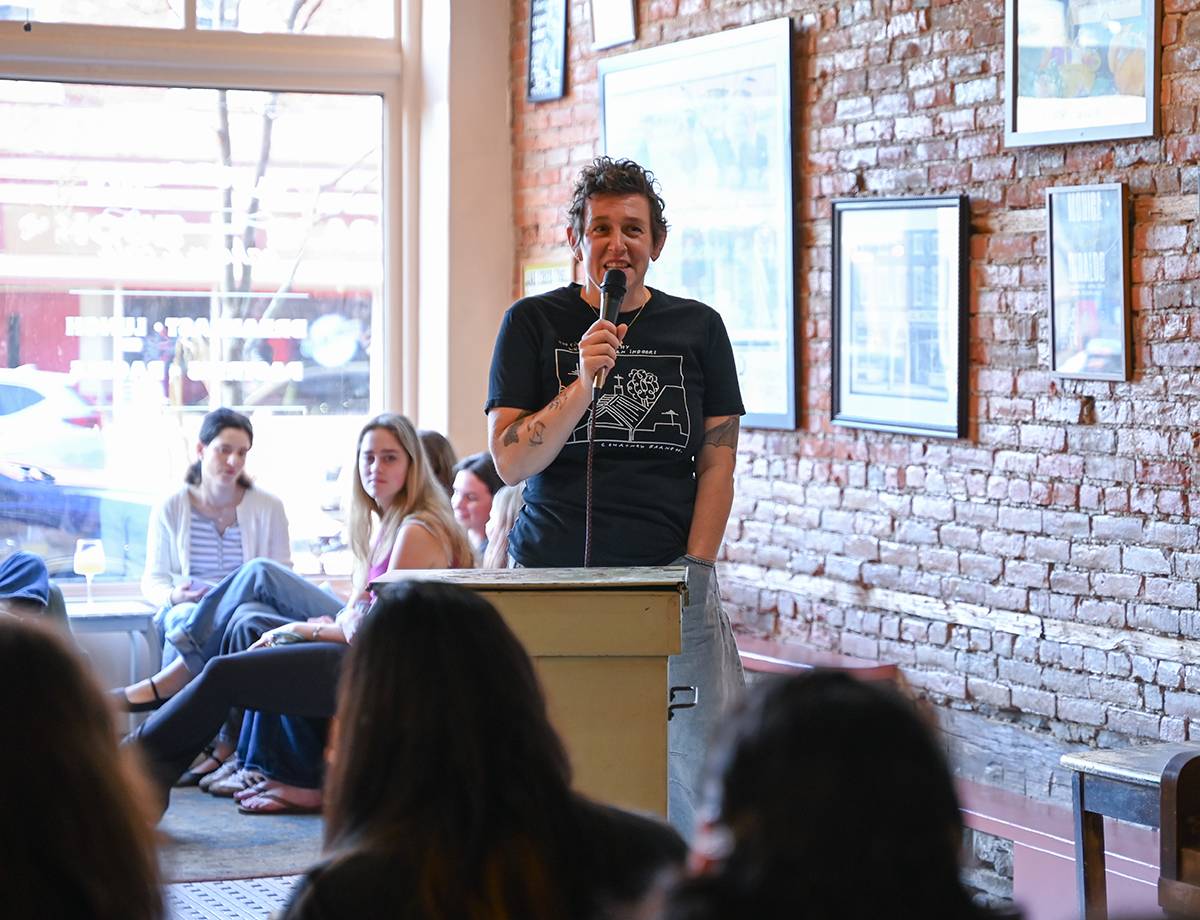
The evening of community and creativity exists because students asked for it. When Associate Professor of English CJ Hauser first taught the class last year, Hauser asked students what they would like to change. Students replied they wanted more chances to share their writing, and even those who didn’t want to get on stage wished they had heard more of their classmates’ work.
Students wrote their imitations in response to prompts Hauser gave them, inspired by the form, content, or themes of each visiting Living Writers author. For his delights, Badrous reread several of Gay’s essayettes, not only to absorb his style but to understand his motive.
“I believed that I needed a reason to write them other than the fact that it was an assignment,” he said. His delight on weird drinks is, on the surface, about enjoying brightly colored, sugary drinks. Underneath, it’s about ordering them without shame despite his friends’ teasing.
Myra Gauri ’29 also read, sharing an imitation of Elena Passarello’s Animals Strike Curious Poses. Her piece carried “the subtle undertone of hunting season and the harm of naming a group of animals or people ‘invasive,’” she said. A biology major, Gauri recently added an English major, a decision she credits partly to Living Writers. Many of the visiting authors spoke about their own lives and the current socioeconomic climate. Meeting them, she said, was “almost like a reminder that it’s not stupid to care.”
Since 1980, writers have come to campus each fall to talk about their books. The series is also open to the public so that people can read along, Hauser said, “so there are books in common in the community that people can make conversation with.”
Students read a book a week, discuss it on Tuesdays, and meet the author on Thursdays before the public talk.
For Badrous, who plans to major in English and economics, the size of the class is a favorite part. “In a class with over 50 people, you hear so many diverse ideas and perspectives that change the way you see the book,” he said.
Not everyone in the class is a writer. “There are a lot of people who are majoring in all sorts of things, and they’re taking this class because they want to spend time reading and thinking about books,” Hauser said. Several students said that reading so many books in a row made it easier to sit down and focus. Many have discovered they enjoy genres they wouldn’t have picked up on their own, like lyric essays and memoirs.
Badrous said he will continue taking creative writing classes at Colgate. “Hearing all of these authors’ stories has lowered the barrier of entry into writing in my mind,” he said. “Previously I thought you needed to be a genius to be an author, but it turns out, you just need something you want to say.”