
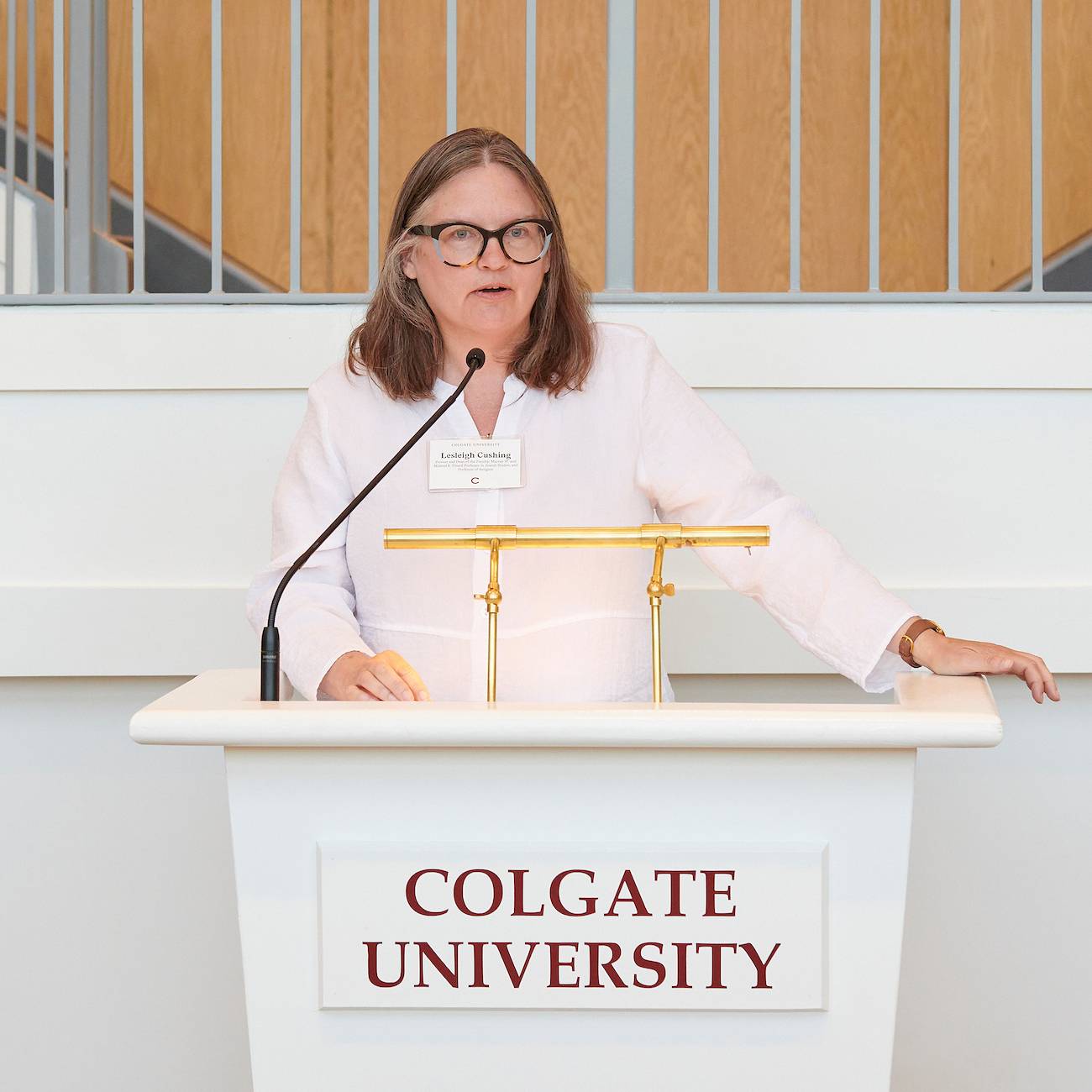
On Saturday, Sept. 19, during family weekend, Colgate University presented a panel to discuss the relationship between Colgate’s curriculum and the evolving role of AI in education. The panel featured Lesleigh Cushing, provost and dean of the faculty; Douglas Johnson, dean of academic and curricular affairs; and Teresa Olsen, interim vice president of student outcomes and Milone Family assistant vice president for career initiatives.
The event offered students and families a look at how Colgate is integrating AI into its curriculum while examining the lasting value of human-centric liberal arts learning.
“Built into our entire system of education is the notion of creating global citizens; of ethical responsibility; of discernment — the ability to judge what is good and true from what is complicated or even wrong,” Cushing said. “We want students to be able to grapple with really complex ideas.”

Johnson continued the conversation by elaborating on the importance of competence and adaptability in the professional world. In particular, he stressed that Colgate teaches students the skills they need to optimize the use of many tools, including the ability to deliberate over and, when necessary, challenge outputs from AI tools.
“[Students] need to become exceptionally good at learning things they do not know, because they’re going to need to do that throughout their entire lives,” Johnson said.
In her comments, Olsen drew on the tangible results that she has seen in the professional achievements of students after graduation.

She noted that at Colgate, students build a foundation for thinking critically about what they are learning. This prepares them to leverage AI well in employment and graduate school. Some of that preparation is working directly with AI and other technology in the classroom and through internships. Olsen said that a Colgate liberal arts education also helps students evaluate the context and results of an AI query in light of the question they’re trying to answer.
Johnson also reflected on critical thinking and learning now for what comes next.
“The enduring value of a liberal arts education lies in its combination of breadth, depth, and intellectual flexibility. It prepares students not simply for a particular job in the moment, but for a future that we can’t fully articulate right now,” Johnson said.