In a world powered by AI, Colgate graduates stand apart for technical sophistication and their distinctly human capacity to navigate complexity with clarity, purpose, and judgement.
The value of a Colgate education lies not in arriving at answers more quickly, but in developing the insight to ask better questions, evaluate the answers, and use emerging technologies effectively.
Students learn to think without AI — and to use it critically once they do. A Colgate education ensures that our graduates are liberally educated and prepared to lead in an AI-shaped world.
Lesleigh Cushing Provost and Dean of the Faculty
AI and the Liberal Arts
As artificial intelligence becomes increasingly ubiquitous, a Colgate liberal arts education is more important — and more valuable — than ever.
Human learning comes first. Then, AI expands possibilities and strengthens the academic experience as Colgate equips students to use the most relevant and up-to-date tools of their disciplines in service of deeper thinking, creativity, and discovery.
The Colgate Model: Fourfold Approach

1. Human-Centered Learning Comes First
We build the foundations of thinking, writing, and problem-solving.
- Early coursework emphasizes original thinking and desirable difficulty.
- Faculty introduce AI intentionally to deepen — not shortcut — understanding.
- Students develop habits of mind that position AI as a partner in inquiry.

2. AI Within the Curriculum
All students engage with AI in meaningful, guided ways throughout their education.
- Students encounter AI across disciplines and learning settings.
- Educators guide students in using AI to research, analyze, create, and iterate.
- AI is both a tool and a subject — students discover its capabilities, limits, and consequences.
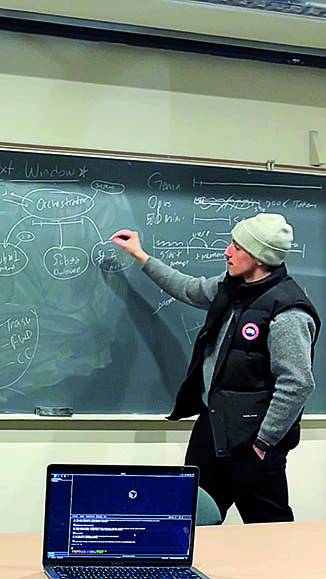
- Tools include locally hosted AI-powered web applications for transcription, translation, code development, image object detection, and more.

3. AI in Research and Innovation
Faculty lead the thoughtful integration of AI into research and creative work, including:
- the use of AI as a tool to generate new forms of artistic expression — under the Arts, Creativity and Innovation Initiative.
- discipline-specific experimentation in research and AI-enhanced scholarship.
- investment in people, tools, and time to explore emerging practices.

4. AI Beyond the Classroom
Students develop AI fluency through applied, real-world experiences, such as:
- micro-credential skill opportunities and partnerships like the Dartmouth-Tuck Bridge Program.
- career-connected experiences that build confidence in using AI effectively and ethically.
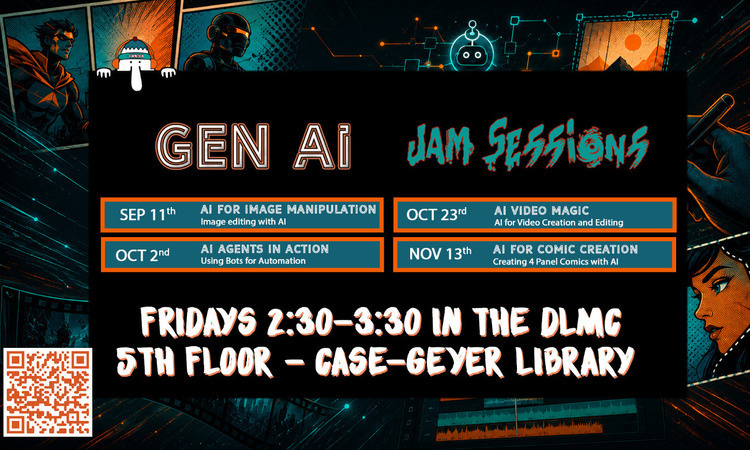
- modules that include AI Agents in Action; AI for Image Manipulation; and Google Gemini, Notebook LM, and Workspace Studio Automation.
How This Shows Up at Colgate
• A coordinated, campuswide commitment to responsible innovation
• Guided use of AI across academic and co-curricular experiences
• Emphasis on process: drafting, revision, and active engagement
• Shared tools and institutional frameworks that support teaching and research
• Clear policies and expectations for AI use, grounded in the Honor Code
The Outcome
With habits of mind cultivated through a liberal arts education, Colgate graduates are prepared to:
• use AI as an assistive technology to amplify their abilities thoughtfully and effectively.
• think independently and critically in an AI-shaped world.
• understand the ethical, social, and global implications of emerging technologies.
• lead with purpose, creativity, and humanity.
News
AI-related Events