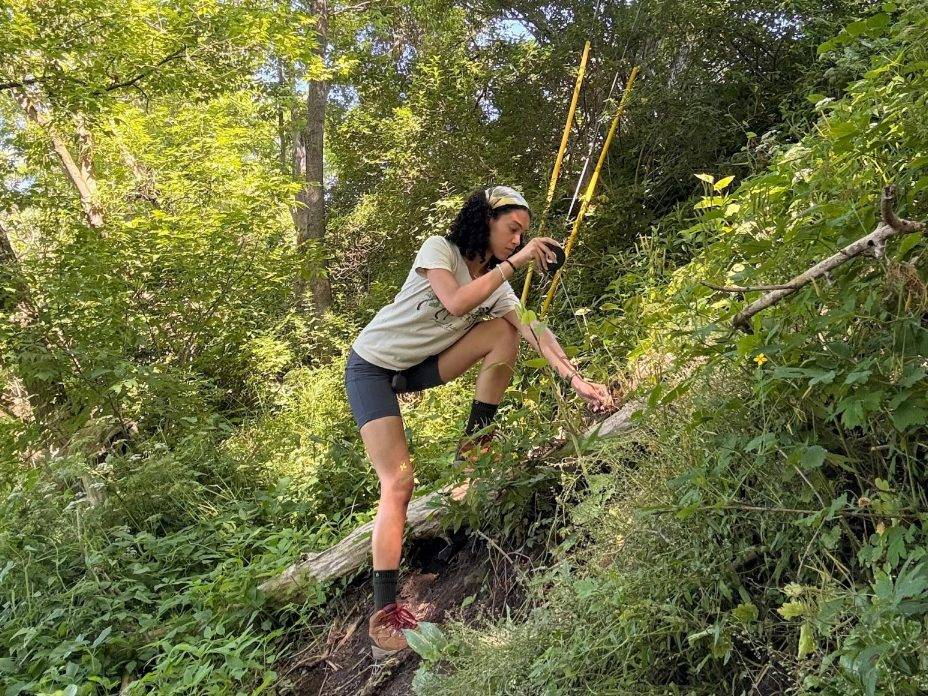
This summer, I had the incredible opportunity to deepen my understanding of local conservation efforts as a Field School Summer Fellow with the Cazenovia Preservation Foundation (CPF). Since its founding in 1967, CPF has served as a vital pillar for the Cazenovia community, protecting 3,800 acres to safeguard the region's historic, agricultural, and natural heritage. Today, the organization maintains 14 miles of multi-use trails across 436 acres of owned land, fostering a meaningful connection between residents and their environment through initiatives such as Trail Thursdays, Poetry on the Trail, and local fishing clinics.
To ensure these landscapes remain resilient for future generations, CPF is embracing new mapping technologies to monitor forest health and climate resilience. My role was to build a knowledge base in preparation for developing an organizationwide invasive species management plan. Building on this mission to protect these cherished spaces, my project specifically addressed the escalating threat posed by invasive species. The goal was to assess the number of invasive species on CPF property, research how best to manage each species, and test which management strategy is more effective and feasible for a nonprofit organization like CPF.
I approached this work in two distinct phases. To begin, I utilized the Finger Lakes Partnership for Regional Invasive Species Management Summer 2026 Trail Survey Program, a community science initiative in which I used the Survey123 mobile app to document invasive species populations while hiking local CPF trails. Second, I conducted an in-depth analysis of management strategies for Japanese Knotweed, one of the most aggressive invasive species in the region, which has established a presence along two CPF trails. By meticulously logging the person-hours required for surveying, measuring, and manually removing Japanese Knotweed, I developed a feasible model. This data-driven framework now allows CPF to predict the time and personnel hours needed to manage future patches based on their size. It was incredibly rewarding to know that the methodology I tested this summer will serve as the strategic foundation for CPF's long-term conservation efforts.
While the fieldwork was rigorous, my time with CPF also offered a unique perspective on the community dynamics of upstate New York, specifically the village of Cazenovia. During my first week I accompanied Executive Director Jennifer Wong on a historical walking tour for local fourth graders. Traversing two miles of town history provided a fascinating crash course in Cazenovia's legacy as a 19th-century industrial hub. Working alongside dedicated volunteers, I quickly observed that, while rolling farmland may physically distance neighbors, the community remains remarkably tight-knit. There is a profound, shared reverence for local history, veterans, and the environment. Citizens actively support organizations like Cazenovia Heritage and CPF not merely to preserve artifacts, but to protect the rural character and agricultural lifestyle that define their home.
As I reflect on my experience as an environmental studies major, I believe this fellowship was the ideal opportunity to bring my academic studies to life. I’ve always thrived on hands-on learning, and this role provided a perfect balance between analytical work in the office and getting my boots dirty in the field. Some of my most memorable moments were spent in conversation with volunteers, learning about the seasons spent harvesting squash and catching pumpkinseed sunfish — experiences that drive their continued commitment to the land. For me, this summer internship has done more than just solidify my dedication to environmental stewardship; it has provided clarity for my professional aspirations. I am leaving this fellowship inspired to pursue a career where I can continue to lead community-based conservation efforts that create a tangible, lasting impact.