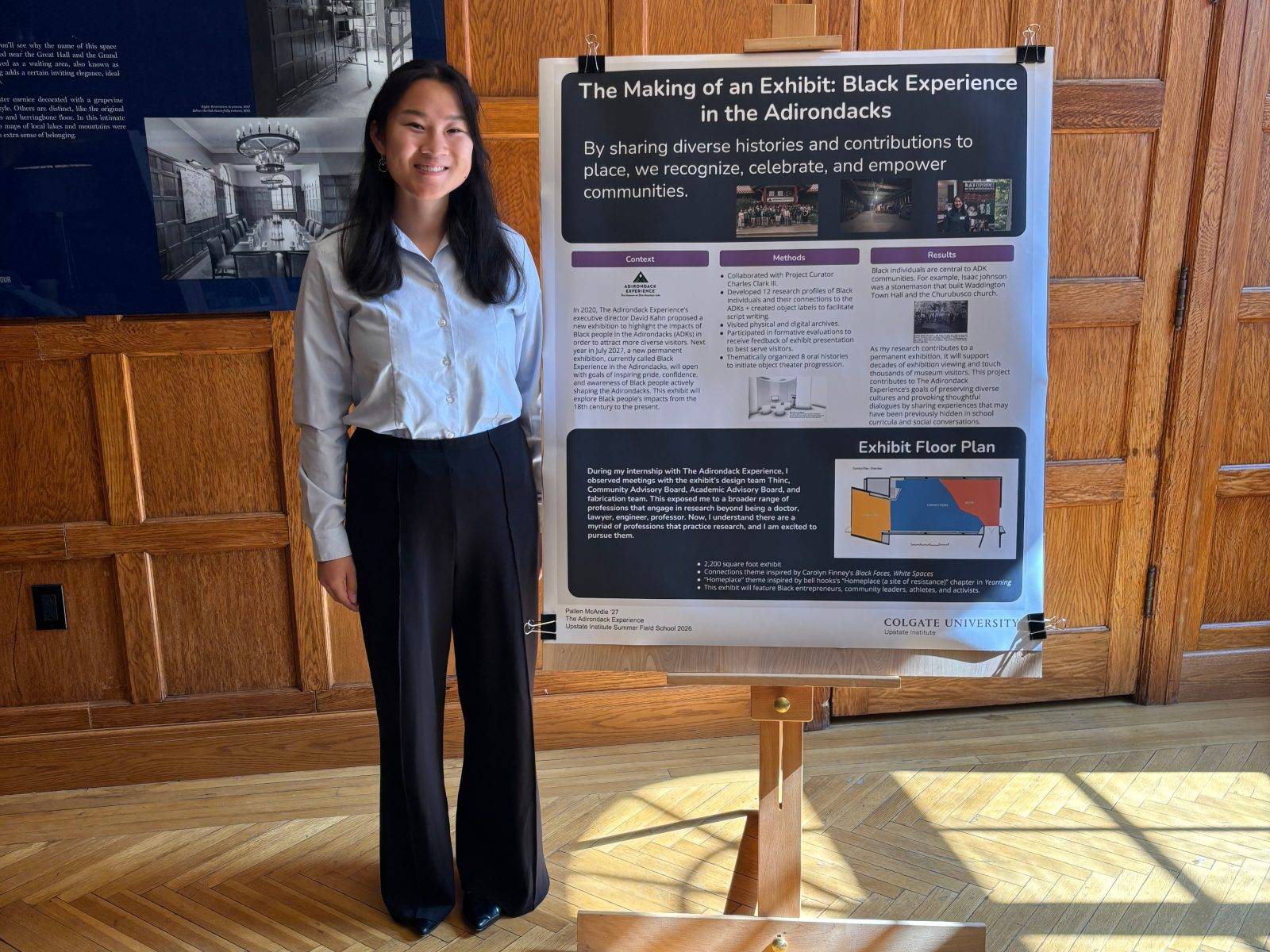
This summer, I interned at the Adirondack Experience, which is a historical, social, and cultural museum dedicated to representing diverse Adirondack stories since 1957. The museum is located in Blue Mountain Lake, NY, in Hamilton County. It showcases several exhibitions about Adirondack art, boating, woods, waters, work, and local communities. In addition to opening for museum visitors seven days a week May through October, the Adirondack Experience collaborates with the community through event partnerships with local businesses, artists, and leaders, and Adirondack school programming. The museum acts as an educational resource to preserve past and present cultures of the Adirondacks.
In 2017, the Adirondack Experience opened a multi-gallery permanent exhibition called Life in the Adirondacks, which highlights Abenaki, Mohawk, urban vacationer, miner, and other community agents and their legacies in connection to the Adirondacks. In 2020, former Executive Director David Kahn proposed a new exhibition to emphasize the contributions of Black people in the Adirondacks. He hoped to attract more diverse visitors and support the museum’s mission of preserving diverse stories. With the support of the Board of Trustees, Kahn secured a multi-million dollar budget and a 2,200 square foot exhibition space for Nature of Belonging: The Black Experience in the Adirondacks permanent exhibition that is located within a gallery within Life in the Adirondacks. Nature of Belonging is set to open next Summer 2027. It is organized into three main themes: work, connections, and homeplace.
For my internship, I focused exclusively on developing the upcoming Nature of Belonging: Black Experience in the Adirondacks exhibit. I primarily collaborated with Project Curator Charles Clark III. My work focused on three projects. I developed 12 research profiles on Black individuals in the Adirondacks from the 18th century to the present to understand how Black people have actively shaped this place. To do this, I visited digital and physical archives including Fort Drum and Fort Ticonderoga. My profiles explored Black people’s contributions to the Adirondacks. These were then transcribed in preparation for supporting the text and audio-visual media in the exhibit.
My next project concentrated on eight existing oral histories. I thematically organized these oral histories to initiate object theater progression by identifying key themes and moments that relate to homeplace as a site of resistance. This fits into our homeplace theme. The object theater is designed to be a comfortable space for visitors to sit and listen to different people’s experiences in navigating the Adirondacks. It will convey hope and resistance. Additionally, I managed part of the oral history administration of paperwork and contacting participants.
Moreover, gaining feedback prior to displaying the exhibit is critical. At the Albany Public Library and on campus at the Adirondack Experience, our team conducted formative evaluations to receive feedback on sample texts, objects, and perceptions of the Nature of Belonging exhibit. The evaluations and community conversations suggested two main responses: “I didn’t know this history existed!” and “I knew about this and it’s so exciting you are sharing this important history!”
Along with inspiring hope and celebrating community connections, Nature of Belonging: The Black Experience in the Adirondacks seeks to fill an educational gap of exploring Black contributions from the 18th century to the present. Many locals and visitors have expressed that they were never taught local Black history, except for enslavement in schools, and the discussion of positive influences of Black communities have been neglected in social conversations too. With Nature of Belonging, the Adirondack Experience addresses this gap in education, and shows how Black people have actively shaped the Adirondacks for centuries. We hope this exhibit will inspire pride and confidence, as well as recognize, celebrate, and empower communities. As my research contributes to a permanent exhibition, it will support decades of exhibition viewing, touch thousands of museum visitors, and provoke thoughtful conversations.
In connecting back to my Colgate education, my internship at the Adirondack Experience compliments my major of peace and conflict studies and minor of Africana and Latin American studies by exploring the relationships between lived experiences and larger institutions, movements, and systems of power. More specifically, my research explores Black agency in a localized place of Black influence across centuries. It challenges colonial and racialized narratives of Black communities, and reframes Black people as agential change makers.
This internship engaged my professional growth more significantly than I had anticipated. It exposed me to a broader range of professions that employ research beyond being a doctor, lawyer, engineer, or professor. It offered me an opportunity to conduct community-based research with a tangible social impact and product involved. I am grateful to the Upstate Institute Summer Field School for giving me this opportunity to engage with a local community and grow my understanding of the professional world. I will bring these experiences with me as I embark upon my professional journey after graduating from Colgate University next year. Now, I understand there are a myriad of professions that practice community-based research, and I am excited to pursue them. I realize there are so many opportunities to research beyond publishing a paper, and that there are so many careers that practice positive social impacts.