It may come as a surprise to many that John Brown, a hallowed name in the Abolitionist movement, lived in a picturesque homestead just outside of Lake Placid from 1849 alongside his family up until his execution in 1859. Since then his home and property have been preserved and are open to the public as a New York State Historical Site. This summer I had the opportunity to work with a nonprofit called John Brown Lives whose work is dedicated to celebrating the legacy of John Brown and breathing new life into his message of radical justice through action.
The way they do this is by working in tandem with the State Historical site to lead events on the property during major holidays such as Juneteenth and the Fourth of July, as well as educating groups of students, workers, educators, and whoever else is willing, on the history and significance of John Brown. Similarly, John Brown Lives works with other advocacy and politically engaged groups and non-profits in the Adirondack region to incentivize civic action from the general public.
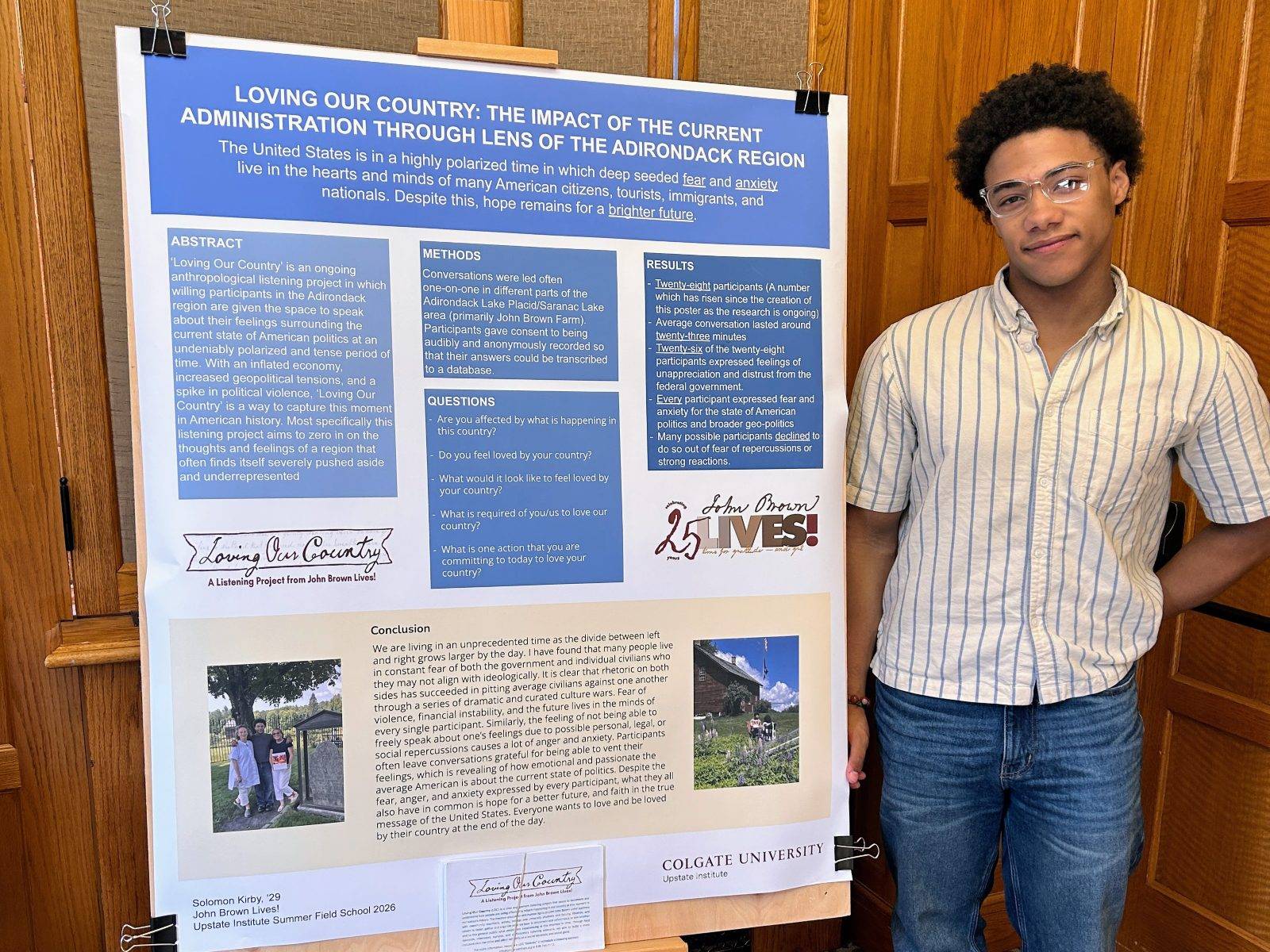
Since May of 2025, John Brown Lives has been working on an initiative called “Loving Our Country,” an anthropological survey in which willing participants sit-down with a “listener” from John Brown Lives and are asked five questions: are you affected by what is happening in this country, do you feel loved by your country, what would it look like to feel loved by your country, what is required of you/us to love our country, and what is one action that you are committing to today to love your country? This summer I worked as one of these listeners, asking these questions to over 30 participants individually. Through this experience I have learned a lot from speaking with people hailing from numerous backgrounds that have informed some of my own political thoughts that I will carry with me for the rest of life.
While the scourge that was American chattel slavery — the main motivator for John Brown’s work — no longer exists, a plethora of systematic disparities and issues prevail in modern American society. No matter what side of the political compass you identify yourself with, it is evident that the United States is currently in a time of heightened polarity and tension with an ever growing rift between the political left and right. Rhetoric from political elites on both sides has succeeded in striking fear into the hearts of average American citizens and it is everyday now that as a people we feel our individual power as civilians dwindle and get lost in a sea of shouting matches and radical thought. This survey by John Brown Lives attempts to address this feeling of helplessness by giving people the space to express their feelings and thoughts surrounding the current state of American polity free of push back.
I often found that participants left each session with a feeling of gratitude. In a world where so many people are talked at and told what to think rather than allowed to think for themselves, simply being allowed to speak unopposed with the idea in mind that what they feel and think matters to the person who is listening is often therapeutic for many.
What I found even more revealing was the amount of potential participants who declined to take part in the project out of fear for the possible repercussions. Even though I would guarantee anonymity and discretion for each person, the fear that what they would say to me would somehow leak to the general public paralyzed some people. The anxiety ranged from social/personal repercussions in which people feared being put at odds with loved ones as a result of what they say, professional repercussions that caused people to fear trouble at work as a result of what they say, all the way to legal repercussions in which people who were maybe immigrants feared their words getting back to homeland security and getting them in trouble with the federal government.
Through this experience I found myself navigating the complexities of politics as seen through the stories of people from all over the country and world. I had people crying in my arms, expressing their desire for armed revolution, and recounting their life stories to me sometimes all in the same day. The answers I received from participants were never the same as every answer was informed by someone’s individual life experiences. Despite the varying responses I received during this project beneath the surface of everything that was said is the desire for prosperity. In truth, the average person seeks to prosper and to see their fellow Americans do the same.
In the present day what I have learned through doing this project is that networks like social media grant the general public a wall of anonymity that creates the perfect environment for radicalism and hatred on both sides to thrive free of consequence. This influx of divisive dogma has succeeded in convincing many that the people around us are our enemies, but through this experience, I have learned that this is not necessarily the case. While radicalism that we see online is very real, it is not representative of a majority of the population. By having these conversations, we bring this reality to the forefront.
Through my experience with John Brown Lives I have learned that one of the greatest resources we have as a society is one another. Being able to live with, and listen to each other is of the utmost importance because you realize that we all ultimately want the same things, it is simply the ways in which we go about achieving our goals that differs. This experience with John Brown Lives has taught me many things that I will cherish dearly for the rest of my life.