A critical flaw at eMudhra, a global certificate authority, has led Microsoft, Google, Apple, and Mozilla to remove trust in several of its root certificates. Colgate’s systems were never compromised, but we must replace our certificates to keep pace with these changes.
On Friday, November 13 at 5:00 a.m., ITS will update the certificate for the eduroam wireless network. When you connect after that time, you may be prompted to accept the new certificate.
How Web Security & Trust Chains Work
Whenever you connect to a secure website or campus network, your device uses encryption to keep your data private and to confirm that the site or network on the other end is legitimate. Both jobs rely on asymmetric (public key) cryptography.
Every secure server holds a matched pair of keys. The private key is a secret number that never leaves its owner. The public key is derived from it and shared with everyone. Anything signed with the private key can be verified by anyone with the public key, but the public key can’t be used to work backward to the private one.
A common way to picture this is mixing paint. Start with a can of yellow paint that everyone has. Choose a secret color of your own and stir it in. You can show the resulting blend to the whole world, because mixing is easy and un-mixing is practically impossible. If you’ve ever tried to touch up a wall without the original can, you know how hard it is to work backward from a finished color. The blend is your public key. The secret color is your private key.
The only way to attack this is to guess: pick a color, mix it with yellow, and see if it matches. The protection depends entirely on how many secret colors there are to choose from. For the type of key involved in this incident, the secret is drawn from a pool of roughly 10115 possibilities, ten septentrigintillion, a 1 followed by 115 zeros, or:
Every private key is a single number picked at random from that enormous range. In paint terms, it’s one secret color out of all those possible shades. These secret numbers are what hold the “certificate chain” together:
Built into your device
Signed by the root
Signed by the intermediate
Major tech vendors (Apple, Google, Microsoft, Mozilla) maintain a strictly guarded list of trusted Root Certificates built into your devices. A Certificate Authority (CA) uses its root to sign intermediate certificates, which in turn sign the certificates for individual websites and network services. Each link is a signature made with a private key, so if any private key in the chain can be guessed, anyone can sign certificates in its name.
What Happened? (The eMudhra Flaw)
In October 2026, a security researcher discovered that eight intermediate certificates belonging to eMudhra, a global Certificate Authority, had been created with badly broken private keys. Instead of a number picked at random from that enormous range, a flaw in eMudhra’s key generation process left each of the eight keys with a value under 256. One key was literally the number 4.
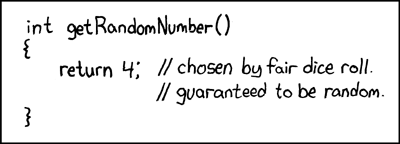
“Random Number,” xkcd #221 by Randall Munroe (xkcd.com/221)
In paint terms, the shelf held fewer than 256 secret colors instead of ten septentrigintillion. Anyone could mix each one with yellow, compare it to the public blend, and find the match in under a second.
With a private key in hand, an attacker could sign fake certificates for any website on the internet, and every device that trusted eMudhra’s chain would accept them as real.
How This Impacts Colgate
None of Colgate’s certificates were signed by eMudhra’s broken keys, and no Colgate system was compromised.
Like most U.S. colleges and universities, Colgate gets its certificates through InCommon, a service run by Internet2 for higher education. In summer 2026, InCommon moved its certificate service to eMudhra. InCommon’s own intermediate certificates were created correctly and were never breached, but they chain up to eMudhra’s root certificates. When the major vendors decided they could no longer trust those roots, every certificate beneath them lost trust as well, including ours. Colgate is far from alone: of the roughly 30,000 certificates under the first root removed, nearly all belonged to InCommon schools.
Here’s a timeline summary:
- Late October: Vendors removed trust in eMudhra’s G3 root. Some of Colgate’s certificates chained to G3, and ITS reissued them within days under a second eMudhra root, G1, without service disruption. Most of our certificates already chained to G1 and were not affected.
- Early November: After eMudhra announced it would exit the certificate business, Google and Mozilla said they would not trust G1 certificates issued after November 16, and Apple said it would remove G1 entirely on November 30.
- November 10: Microsoft announced it will remove G1 on Monday, November 16. From that day, Windows and Edge will reject any certificate that still chains to G1.
This accelerated timeline gives ITS until Sunday, November 15 to re-key and rotate all campus certificates to a new provider, SSL.com.
What to Expect
Starting Friday morning, when you connect you may be prompted that a certificate is needed to join the “eduroam” network. Choose “View Certificate” and confirm the certificate belongs to clearpass.colgate.edu and is issued by “SSL.com TLS Issuing RSA CA R1”. Choose Accept (or Trust or Connect, depending on your device), and you’ll be back online as usual. You may see this message once on each device you use.
Traveling? If you use eduroam at another college or university, you’ll see the same prompt there and can accept it the same way.
Having trouble connecting? Remove the eduroam network from your devices, then follow the step-by-step instructions on the ITS website: https://colgate.edu/getconnected.
If you have questions, please contact the ITS Service Desk at 315-228-7111 or email itshelp@colgate.edu.