BA, Luther College
PhD, University of Washington

Rick Geier
Warren ’43 and Lillian Anderson Chair in Chemistry; Professor of Chemistry
Department/Office Information
ChemistryEducation
Professional Experience
- Director, Division of Natural Sciences and Mathematics, 2022-2025
- Department Chair, Colgate University, 2019-2022
- Warren ’43 and Lillian Anderson Chair in Chemistry, Colgate University, 2018-present
- Professor, Colgate University, 2014-present
- Department Chair, Colgate University, 2010-2013
- Associate Professor, Colgate University, 2006-2014
- Visiting Scholar, Rensselaer Polytechnic Institute, 2004
- Assistant Professor, Colgate University, 2000-2006
- Research Assistant Professor, North Carolina State University, 1999-2000
- Postdoctoral Research Associate, North Carolina State University, 1997-1999
Specialties
Organic chemistry
Teaching Experience
CHEM 101/102: General Chemistry I and II
CHEM 263/264: Organic Chemistry I and II
CHEM 381: Practical Quantitative Analysis
CHEM 461: Organic Reaction Mechanisms
CHEM 464: Organic Synthesis
CHEM 468: Medicinal Chemistry
CORE 105: Science and Implications of Nanotechnology
Research Interests
Studies of porphyrinoid synthetic methodology and porphyrinoid properties
Research in the Geier laboratory is directed towards investigation of methods for the preparation of a variety of porphyrinoids. Successful syntheses facilitate studies of porphyrinoid properties such as stability, spectroscopy, metal binding, and catalysis.
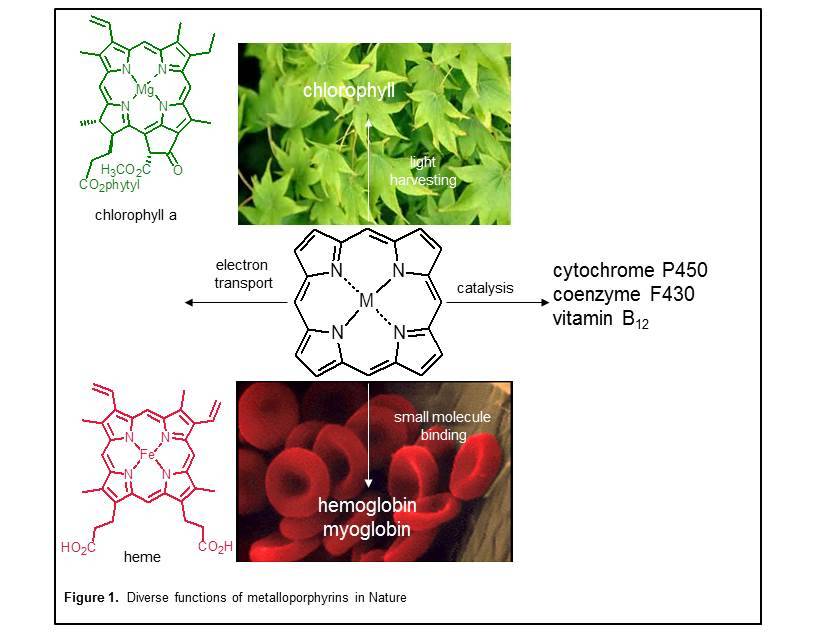
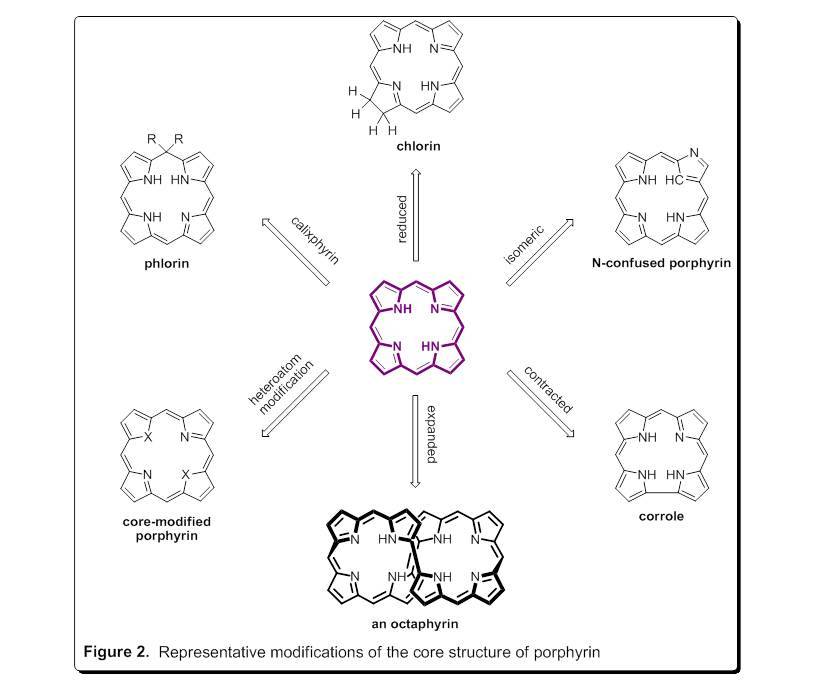
Porphyrins perform diverse functions in Nature (Figure 1). For example, the characteristic red color of blood and green color of plants are due to porphyrinoids (heme and chlorophyll, respectively). The rich array of porphyrin function arises from the variety of ways in which macrocycle properties can be fine-tuned. The identity of the central metal ion and axial ligands are important. The protein matrix surrounding the porphyrin ring also influences macrocycle properties. And of particular interest to our research group, the core structure of the porphyrin can be substituted, reduced, heteroatom modified, isomerized, expanded, and/or contracted relative the prototypical porphyrin structure.
Structural alterations to the porphyrin macrocycle gives rise to a large family of molecules that display a wide range of complementary properties (Figure 2). Some of the general structures shown in Figure 2 are found in Nature. Others have been created in the laboratory in an effort to produce porphyrinoids of fundamental interest, and materials useful for a wide range of commercial applications including molecular electronic devices, solar energy, photodynamic cancer therapy, ion selective sensors, and catalysis.
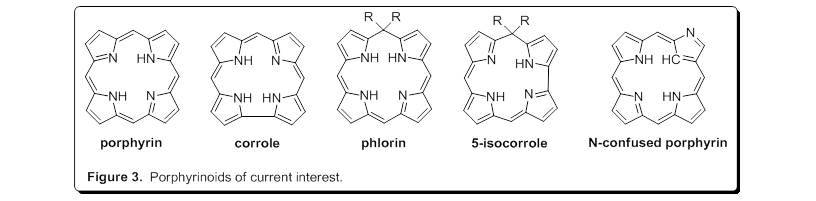
In the Geier research group, we have a number of ongoing projects involving many of the porphyrinoids shown in Figure 2. Presently, we are exploring the series of compounds shown in Figure 3. The central core of the porphyrinoids differ in subtle, but profound ways which impact metal binding and properties of the metal chelates. To forward these efforts, our group has contributed methodology for the preparation of corroles (J. Org. Chem. 2004, 69, 4159-4169), phlorin (J. Org. Chem. 2007, 72, 4084-4092; J. Org. Chem. 2016, 81, 5021-5031), and 5-isocorrole (J. Org. Chem. 2010, 75, 553-563). Recently, we reported a streamlined, one-flask synthesis of an N-confused porphyrin bearing pentafluorophenyl substituents (J. Org. Chem. 2017, 82, 4429-4434). The phlorins prepared by our group are noteworthy as they are among the most stable phlorins known towards degradation in light and air. Metal coordination of a 5-isocorrole has been investigated in collaboration with the Ziegler group at The University of Akron (Dalton Trans. 2011, 40, 4384-4386). Magnetic circular dichroism studies have been performed on transition-metal complexes of the perfluorophenyl-N-confused porphyrin in collaboration with the Nemykin (University of Manitoba) and Ziegler groups (J. Phys. Chem. A.2017, 121, 3689-3698). Further studies of the coordination chemistry of these porphyrinoids are ongoing. We also continue to target additional novel porphyrinoids in our synthetic investigations.
We utilize a broad range of experimental techniques in our work including preparative organic synthesis and purification methods (extraction, distillation, sublimation, chromatography, and crystallization), parallel analytical-scale reactions, analytical chromatographic methods (GC and HPLC), and a variety of spectroscopic tools (NMR, UV-vis, IR, EI-MS, and LD-MS).
Please make an appointment with Professor Geier to discuss current research opportunities in the Geier laboratory.
Further Readings
Excellent reviews of many topics germane to this research may be found in The Porphyrin Handbook, Kadish, K.M.; Smith, K.M.; Guilard, R., eds. Academic Press, 2000; and in The Colours of Life, Milgrom, L. R., Oxford University Press: New York, 1997.
Distinctions
External Funding (PI): American Chemical Society Petroleum Research Fund, Type G, 2002-2005; Research Corporation, Cottrell College Science Awards, 2002-2005; National Science Foundation, Course, Curriculum, and Laboratory Improvement-Adaptation and Implementation, 2003-2006; National Science Foundation Research at Undergraduate Institutions, 2005-2008. National Science Foundation Major Research Instrumentation, 2021-2024.
External Funding (Co-PI): National Science Foundation, Course, Curriculum, and Laboratory Improvement-Adaptation and Implementation, 2001-2003; National Science Foundation Major Research Instrumentation, 2008-2011; National Science Foundation Major Research Instrumentation, 2017-2020.
Publications
- Muldowney, B. E; Ajayi, N. D.; Chen, W.-Y.; Geier, G. R., III; Ziegler, C. J.; Nemykin, V. N. “Structure and Spectroscopy of Free Base, Copper, and Zinc Tetrapentylporphyrin,” J. Phys. Chem. A. 2026, 130, 4594-4605.
- Doble, S.; Osinski, A. J.; *Holland, S. M.; *Fisher, J. M.; Geier, G. R., III; Belosludov, R.V.; Ziegler, C. J.; Nemykin, V. N. “Magnetic Circular Dichroism of Transition-Metal Complexes of Perfluorophenyl-N-Confused Porphyrins: Inverting Electronic Structure through a Proton,” J. Phys. Chem. A. 2017, 121, 3689-3698.
- *Fisher, J. M.; *Kensy, V. K.; Geier, G. R., III “Two-Step, One-Flask Synthesis of an N-Confused Porphyrin Bearing Pentafluorophenyl Substituents,” J. Org. Chem. 2017, 82, 4429-4434.
- Kim, D.; *Chun, H.-J.; *Donnelly, C. C.; Geier, G. R., III “Two-Step, One-Flask Synthesis of a Meso-Substituted Phlorin,” J. Org. Chem. 2016, 81, 5021-5031.
- Rhoda, H. M.; Crandall, L. A.; Geier, G. R., III; Ziegler, C. J.; Nemykin, V. N. “Combined MCD/DFT/TDDFT Study of the Electronic Structure of Axially Pyridine Coordinated Metallocorroles,” Inorg. Chem. 2015, 54, 4652–4662.
- *Bruce, A. M.; *Weyburne, E. S.; Engle, J. T.; Ziegler, C. J.; Geier, G. R., III “Phlorins Bearing Different Substituents at the sp3-Hybridized Meso-Position,” J. Org. Chem. 2014, 79, 5664-5672.
- Ziegler, C. J.; Sabin, J. R.; Geier, G. R., III; Nemykin, V. N. “The First TDDFT and MCD Studies of Free Base Triarylcorroles: A Closer Look into Solvent-Dependent UV-visible Absorption,” Chem. Commun., 2012, 48, 4743-4745.
- Costa, R.; Geier, G. R., III; Ziegler, C. J. “Structure and Spectroscopic Characterization of Free Base and Metal Complexes of 5,5-Dimethyl-10,15-bis(pentafluorophenyl)isocorrole,” Dalton Trans., 2011, 40, 4384-4386.
- *Flint, D. L.; *Fowler, R. L.; *LeSaulnier, T. D.; *Long, A. C.; O’Brien, A. Y.; Geier, G. R., III “Investigation of Complementary Reactions of a Dipyrromethane with a Dipyrromethanemonocarbinol Leading to a 5-Isocorrole,” J. Org. Chem., 2010, 75, 553-563.
- *Braaten, K. C.; *Gordon, D. G.; *Aphibal, M. M.; Geier, G. R., III “Effect of Carbinol Group Placement on Complementary Reactions of Dipyrromethane + Bipyrrole Species Leading to Corrole and/or an Octaphyrin,” Tetrahedron, 2008, 64, 9828-9836.
- O’Brien, A. Y.; *McGann, J. P.; Geier, G. R., III “Dipyrromethane + Dipyrromethanedicarbinol Routes to an Electron Deficient meso-Substituted Phlorin with Enhanced Stability,” J. Org. Chem., 2007, 72, 4084-4092.
- *LeSaulnier, T. D.; *Graham, B. W.; Geier, G. R., III “Enhancement of Phlorin Stability by the Incorporation of meso-Mesityl Substituents,” Tetrahedron Lett., 2005, 46, 5633-5637.
- Geier, G. R., III; *Grindrod, S. C. “Meso-Substituted [34]Octaphyrin(1.1.1.0.1.1.1.0) and Corrole Formation in Reactions of a Dipyrromethanedicarbinol with 2,2'-Bipyrrole,” J. Org. Chem., 2004, 69, 6404-6412.
- Geier, G. R, III; *Chick, J. F. B; *Callinan, J. B.; *Reid, C. G.; *Auguscinski, W. P. “A Survey of Acid Catalysis and Oxidation Conditions in the Two-Step, One-Flask Synthesis of meso-Substituted Corroles via Dipyrromethane-Dicarbinols and Pyrrole,”J. Org. Chem., 2004, 69, 4159-4169.
- Chevalier, F.; Geier, G. R., III; Lindsey, J. S. “Acidolysis of Intermediates Used in the Preparation of Core-Modified Porphyrinic Macrocycles,” J. Porphyrins Phthalocyanines, 2002, 6, 186-197.
- Geier, G. R., III; *Callinan, J. B.; Rao, D. P.; Lindsey, J. S. “A Survey of Acid Catalysts in Dipyrromethanecarbinol Condensations Leading to meso-Substituted Porphyrins,” J. Porphyrins Phthalocyanines, 2001, 5, 810-823.
Asterisks indicate undergraduate student co-authors who conducted their research in collaboration with a faculty member at Colgate.
Dissertation
The Preparation of a Metalloporphyrin-Peptide Conjugate Artificial Protein for the Catalytic Oxidation of Alkenes